This is the twenty-sixth article in a catalogue of John Sell Cotman’s first series of etchings published in 1811. Here we continue the examination of plate 22 showing Crowland Abbey, to consider the sequence of major works that he devoted to the same subject.

Croyland Abbey, Lincolnshire, 1811
Private collection
Photograph: Professor David Hill
Cotman’s visit to Crowland in 1804 (see part #1) provided the material for five exhibits; two at the Royal Academy in 1805, nos. 509 ‘Croyland Abbey, Lincolnshire’ and 626 as Gateway of Croyland Abbey’, and three at the Norwich Society of Artists; one in 1807 no.45 ‘Croyland Abbey’, another in 1810 no.57 ‘Croyland Abbey, Lincolnshire’, and a third in 1811 no.64 ‘West Front of Croyland Abbey, Lincolnshire’. The surviving work consists of a fine pencil drawing that came onto the market in 2017, two major studio watercolours of the west front, one at Norwich Castle Museum and the other at the Ferens Art Gallery, Hull, a grand distant view in watercolour at the British Museum, together with the present etching. Besides that there is a small watercolour study at the Tate and an untraced pencil study, last recorded as being with the dealer Stanhope Shelton in 1975. How the surviving works might be aligned with the documented exhibits is a matter for conjecture. One substantial watercolour was recorded as being in the collection of the Marquis of Stafford at Trentham Park, Staffordshire in 1824.
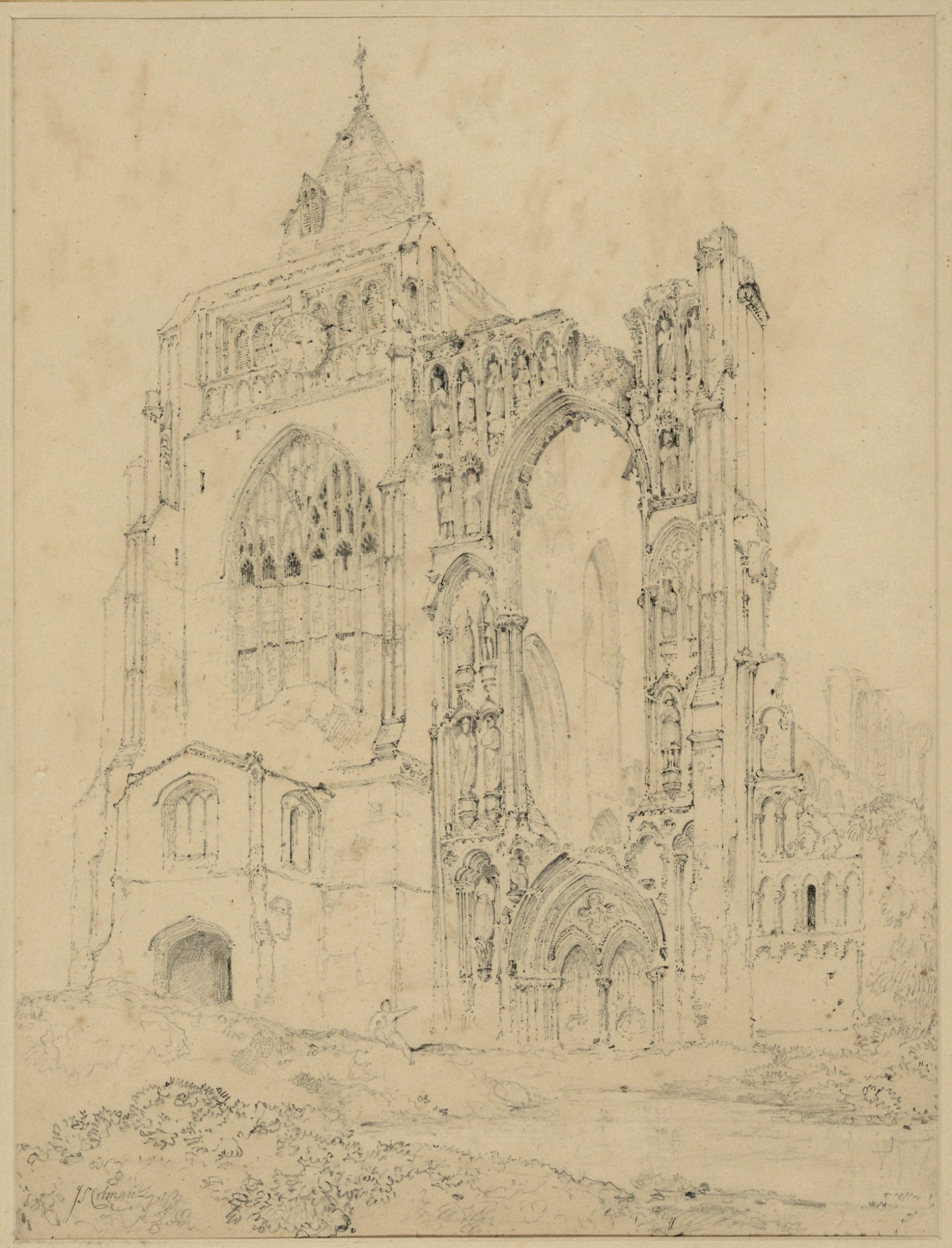
The west front of Crowland Abbey, Lincolnshire, 1804c
Graphite on paper, 390 x 295 mm, 15 3/8 x 11 5/8 ins
Sold at Lawrences Auctioneers of Crewkerne, 14 July 2017, lot 1662
The prime treatment of the west front is the drawing that appeared on the market in 2017. This is a tour-de-force pencil composition, designed to showcase the artist’s abilities as a draftsman. It seems unlikely that he would have exhibited such a work. As a pencil drawing, it would have made little impression amongst coloured works, but it would have served to demonstrate his exceptional talents when shown in portfolios to prospective patrons and students, either at his studio or in the houses that he visited.
Click on any image to open full-size in gallery view. Close gallery to return to this page

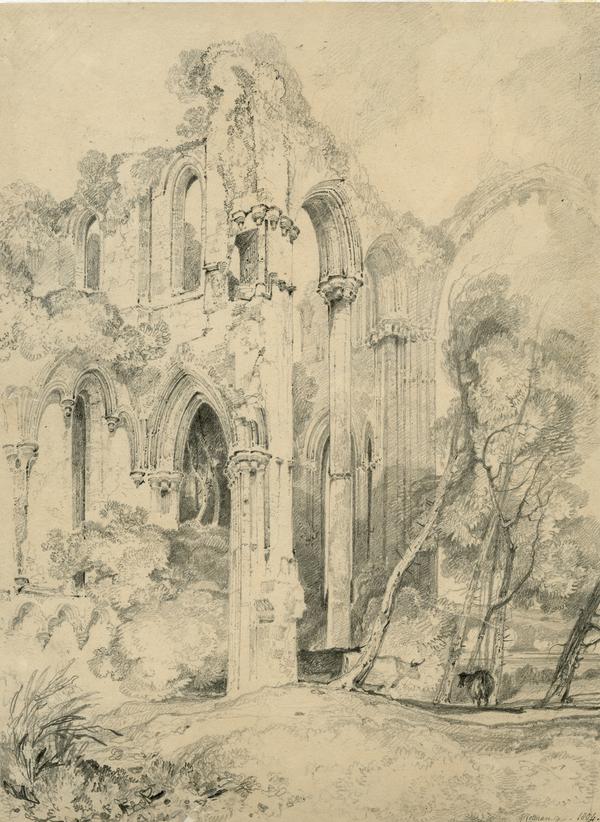


The drawing is one of a group of similarly sized pencil drawings derived from sketches of this period, including Rievaulx Abbey (Tate), Fountains Abbey (Norwich Castle Museum), Howden (YCBA) and St Mary’s York (Private Collection). Of these, Rievaulx and Howden seem particularly close in style.
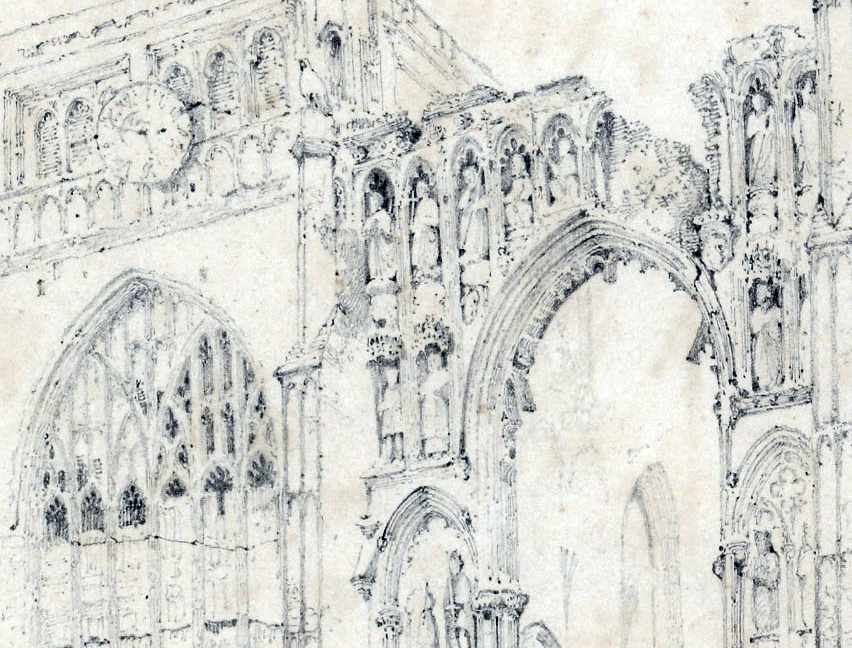
The Crowland pencil is extraordinary in the deftness and particularity of its detail. The clock specifies the time of day as nearly ten to six in the late afternoon, when the light shines optimally onto the west face. Cotman gives his finest care to every single feature, including each louvre in the belfry arcade, the variety of patchings and crackings in the church west widow, the fragile canopies over figures, and, set into relief by the shadow behind, every identifiable attribute of the statues on the west front. One of Cotman’s favourite devices in the first phase of his maturity c.1803-10, is the use of negative space, i.e. the making out of forms by filling in the shaded areas beyond. The effect is deployed here with microscopic care and sensitivity.

The west front of Crowland Abbey, Lincolnshire, 1804
Graphite and watercolour on paper, 420 x 355 mm, 16 1/4 x 14 ins
Signed and dated in brown ink lower right ‘J S Cotman 1804’
Norwich, Castle Museum, NWHCM : 1951.235.251
Scanned by Professor David Hill from black and white reproduction in Cotman: Early Drawings (Norfolk Museums Service, 1979), pl.15, no.29
The pencil is very closely related to a watercolour dated 1804 at Norwich Castle Museum. The architectural form and detail corresponds as closely to the pencil as the watercolour medium will allow, except for the building being given slightly more space to either side, and the composition being elaborated in the foreground with cattle, pigs and a broken plough. As well as the watercolour corresponds to the principal detail of the pencil, however, it does fall short in the peripherals. The details of the main portal and the church porch, for example, are much inferior. One door of the portal appears to be rather larger than the other. The louvres of the belfry are fudged over, and the time on the clock, though generally correspondent, is not exactly the same. The hour hand is slightly tardy, and rests over the ‘V’ rather than closer to the ‘VI’. It has also to be said that the foreground staffage does not altogether enhance the effect. Cotman introduced pigs into several of his compositions around 1804, and seems to have been prone to over-proliferating the picturesque. The composition might also have been better without the plough. Those details notwithstanding, the Norwich watercolour has some very great strengths. The atmospheric chiaroscuro is masterful, and his treatment of the shuttered, plastered and patched-up wreck of the church west window has the unique technical and affective strength of his maturity.
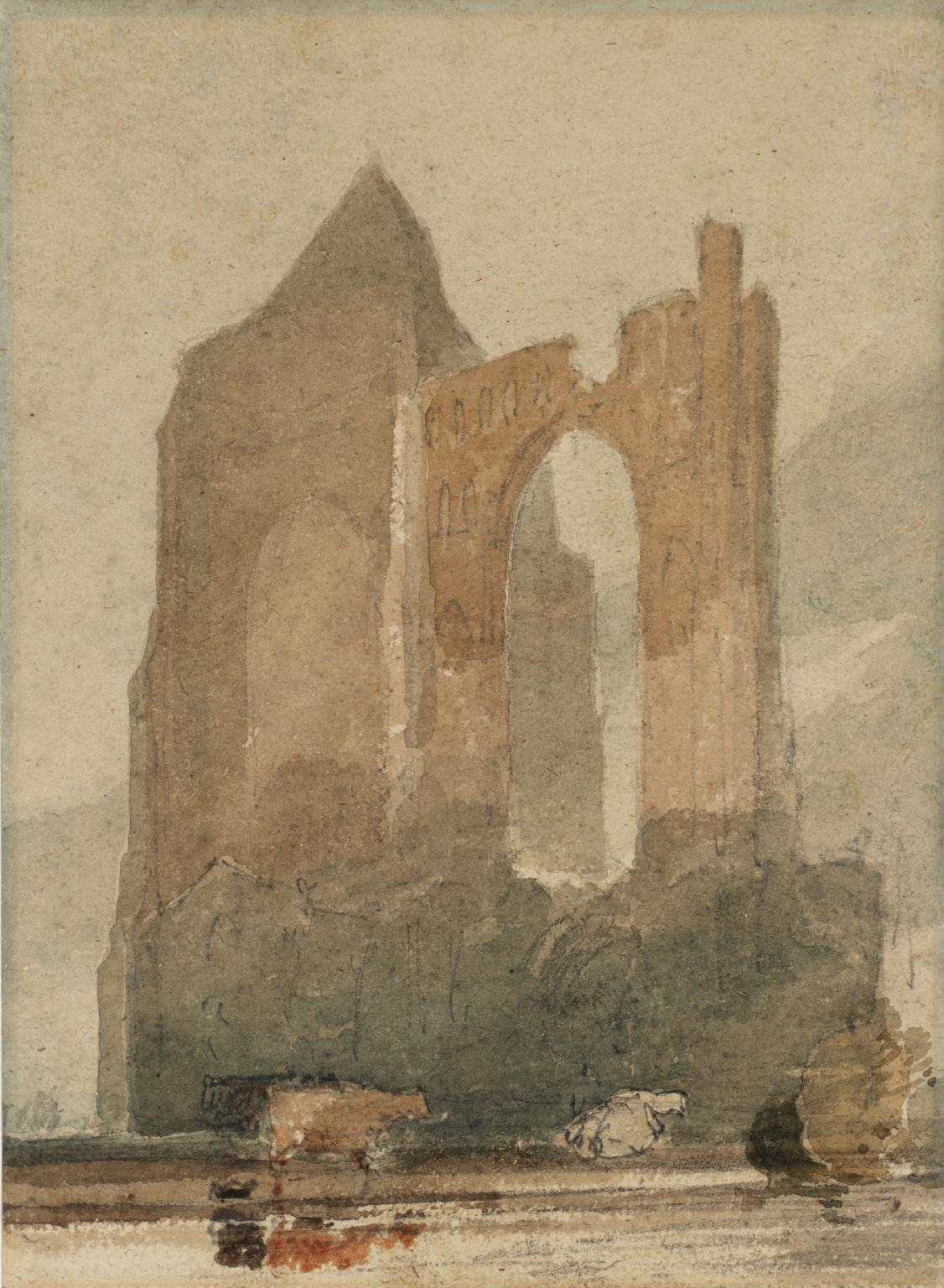
Sometime after completing the Norwich watercolour Cotman decided to produce a second version of the composition. He began the process with a small watercolour study at the Tate. His major objective appears to have been to Increase the drama of light and atmosphere. The time of day is now set as evening in midsummer, with the sun setting, just at the point the light begins to lift from the ground and the dark begins to thicken. The study also sets the subject in a more emphatically level Fenland landscape, and much reduces the foreground incident.
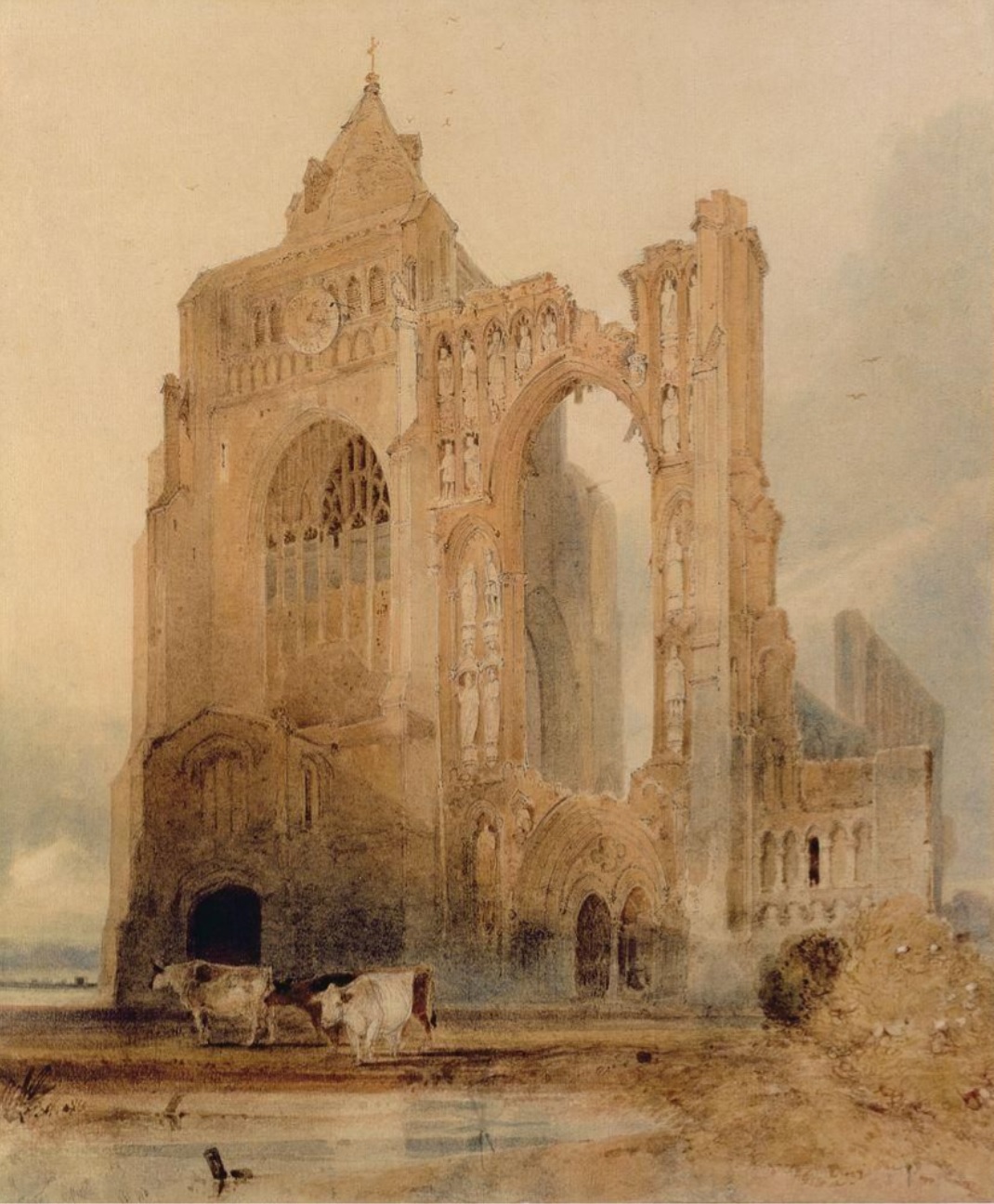
The west front of Crowland Abbey, Lincolnshire, 1805c?
Watercolour, 540 x 452 mm, 21 1/4 x 17 3/4 ins
Hull, Ferens Art Gallery KINCM:2006.7188
The result is perhaps the culminating point of Cotman’s essays in the kind of atmospheric sublime subject popularised by Turner. Cotman clearly intended it as a major statement, for it is nearly twice the size of the Norwich watercolour and one of the grandest conceptions of his career thus far. The church west window is even more delicately treated than in the Norwich version, and the statuary is accentuated in the last light, but elsewhere much of the detail is subordinated more to aesthetic effect. The portal and the church porch are vague in the darkening atmosphere, and the details of the belfry and north aisle arcades are softened. More strangely, the clock appears to be wrong. The hands read just after quarter past one, but the light is in the north-west at sunset in midsummer so the time should be about 9.30 pm. This seems odd. Cotman has clearly recognised a need to change the time from that depicted in the pencil drawing and the Norwich watercolour, but his thinking seem to have gone decidedly awry.
The Norwich watercolour the earliest in style of Cotman’s watercolour treatments of Crowland and there is a distinct aesthetic progression between that and the Ferens watercolour, but Cotman advanced rapidly in the period 1804-5, and either might be identifiable with the work exhibited in 1805 at the Royal Academy no. 509 ‘Croyland Abbey, Lincolnshire’. On the whole, however, given the ambitious size of the Ferens watercolour, that is perhaps the more likely of the two. Its companion in the same exhibition, , no. 626 ‘Gateway of Croyland Abbey’, however remains a mystery. Not the least part of that problem is the fact that there is no gateway at Crowland Abbey, nor, indeed, any feature that could be readily described as such. Perhaps some unknown composition will present itself one day.
Equally, either the Norwich or Ferens watercolour might be identifiable with that owned by the Marquis of Stafford at Trentham Park, near Stoke, and which was recorded as hanging in the drawing room there in 1824. The Marquis was one of the wealthiest collectors of the Regency period and presumably inclined to purchase works that had attracted attention at the Royal Academy. Cotman visited Trentham Park in the summer of 1806, and it seems possible that he was invited to see his work set in place.
In 1806 Cotman’s London career seems to have come off the rails. His exhibits at the Royal Academy that year seem to have failed entirely, and later that year he decided to beat a retreat to his native Norwich in order to mend his fortunes. The years that followed were some of his most artistically adventurous. He learned to paint in oils, took up portraiture and experimented across a range of genres including history painting, marine painting, still life, genre, topical and military. He gradually heightened the colour and saturation of his watercolours, no doubt influenced by his experience with oil, and in between all this produced some of the most radical, grand and challenging work of his career.
During this period he exhibited two treatments of Crowland Abbey. The first was at the 1807 exhibition of the Norwich Society of Artists; no.45 ‘Croyland Abbey’, and the second was at the 1810 exhibition of the same society, no.57 ‘Croyland Abbey, Lincolnshire’.
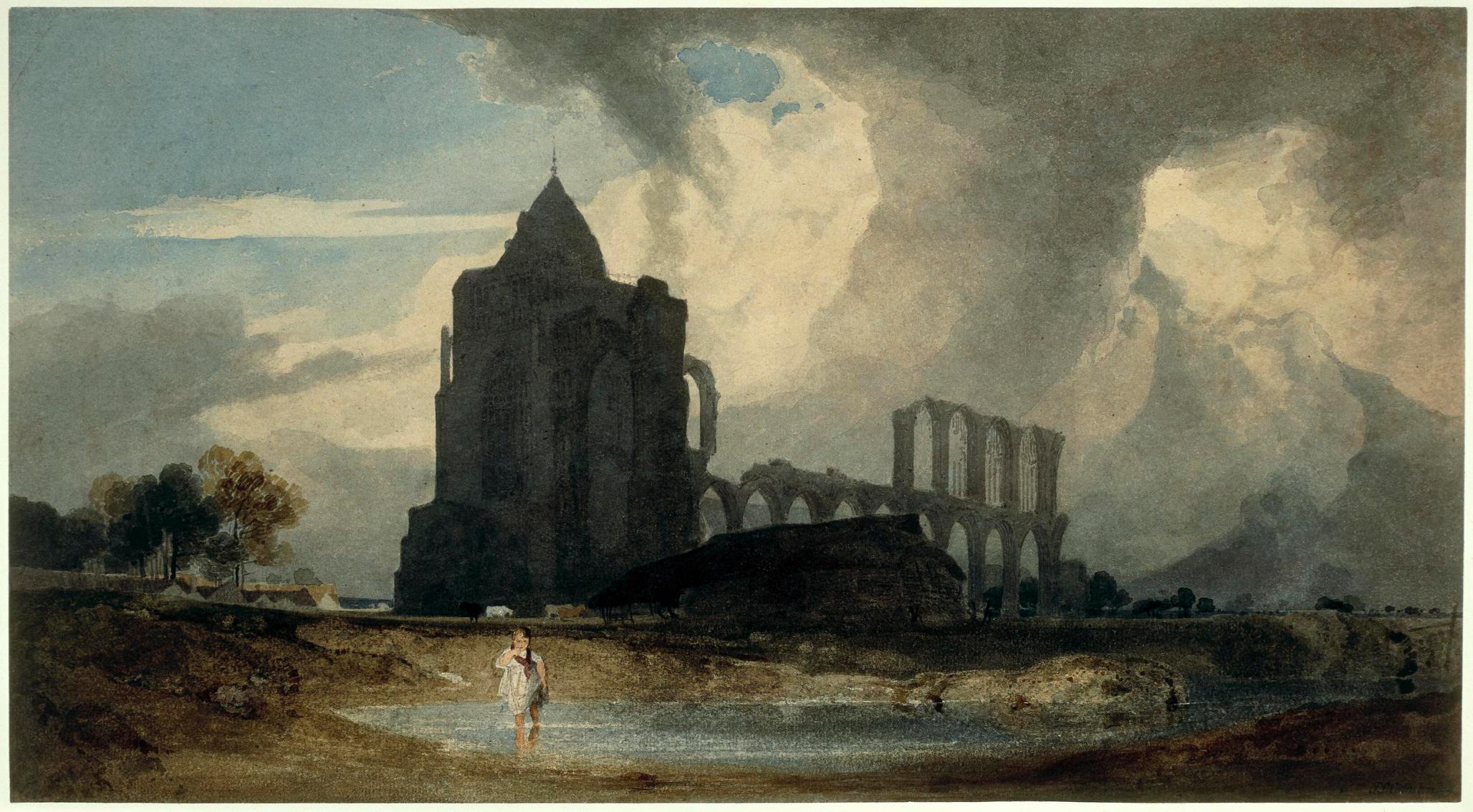
The west front of Crowland Abbey, Lincolnshire, 1807?
Watercolour, 295 x 537 mm, 11 ½ x 21 1/8 ins
Inscribed lower right ‘J.S.Cotman’
British Museum, London, 1859,0528.118
The first is generally identified with a watercolour at the British Museum. Cotman gives a south-west aspect similar to the earlier compositions, but from a greater distance, to bring in the whole of the nave arcades, and a greater sweep of the landscape setting. Compared to the earlier compositions Cotman has a completely different set of priorities. The antiquarian and architectural detail is subordinated to the broad silhouette of the ruins, set against a tumultuous sky. The whole composition relies on bold masses to produce an impedingly sublime effect. Cotman had produced a few such compositions previously, very much in the some idiom as Turner [cf. e.g. watercolours of Newburgh Priory Yorkshire exh 1804 (Private collection, reproduced in colour in Cotman in the North, 2005, p.59) or [so-called] Gormire Lake in the same exhibition (British Museum) but he had never produced anything quite so stern or frankly bold. The primordiality is only relieved by the child in the foreground. Innocent of any portents, she happily paddles in the ditch, recently replenished by the storm.
After moving back to Norwich in the second half of 1806. Cotman was extremely busy. He took a house in Wymer Street, Norwich and for two weeks after Christmas opened his rooms to the public to exhibit over 500 works. This must have been almost the entirety of his stock in trade, and he even bolstered the display with works borrowed back from patrons. His obvious purpose was to present his return to his native city as something of a triumph, and to attract pupils to his new-founded drawing school. No-one could have offered a studio more richly endowed with treasure. He also embarked on painting in oils and styled himself as a portrait painter. By the time that the Norwich Society of Artists exhibition arrived in August 1807, he had twenty new works to show including six portraits and a study after Van Dyck. Besides the Croyland there were also fine watercolours of Durham, Wales, four Norwich subjects and a marine subject of Dutch Boats. We have considered the occasion before in Sublimesites so it is probably sufficient here to say only that the 1807 watercolour of Crowland Abbey was part of a general widening of Cotman’s scope and ambition. It appears, moreover, that he received some encouragement for his efforts. The British Museum watercolour was bought by Dawson Turner, and was acquired by the Museum from his the Yarmouth banker’s sale in 1859.
Cotman’s productivity ran red hot for the next three years. In 1808 he swamped the Norwich Society of Artists with no fewer than sixty-seven exhibits. In 1809 he showed thirty-eight, many of them belonging to a new initiative of a circulating library of drawings in portfolios. In 1810 he showed twenty-three works and in some of these attained a peak of ambition for the decade. Among them, for example, was the large ‘Harvest Field – A Pastoral’ at Leeds Art Gallery and a splendidly formal and grand ‘Durham Castle and Cathedral’ at Norwich Castle Museum. The exhibits that can be identified all have a stately formality of design, as well as saturated and weighty colouration. One exhibit was no.57 ‘Croyland Abbey, Lincolnshire’. This has remained resolutely unidentified, but there is a candidate at the British Museum that we can here bring into play.
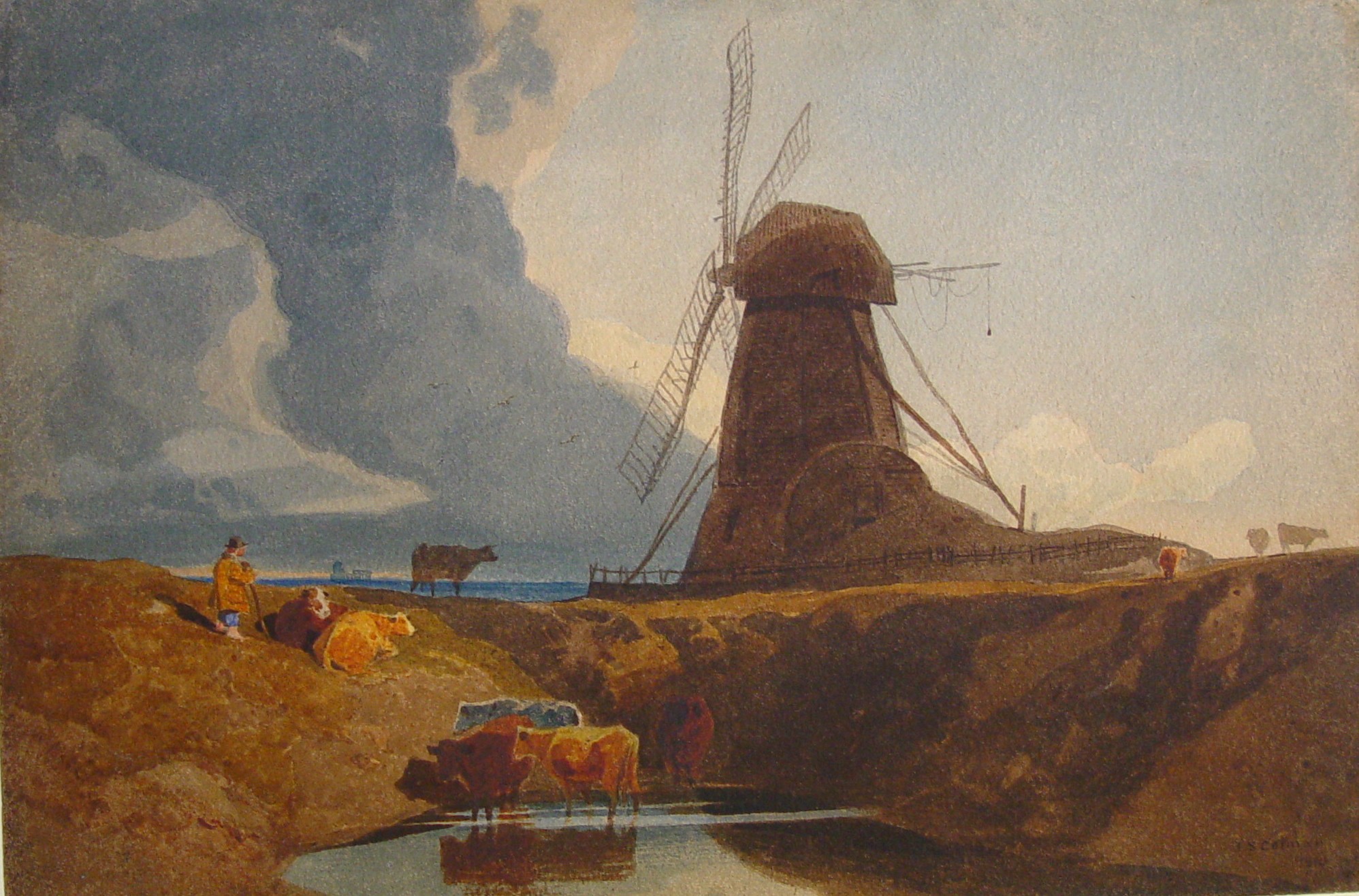
Draining Mill with Crowland Abbey in the distance, 1810
Watercolour on paper, 336 x 505 mm,
British Museum, London, 1902,0514.19
The British Museum watercolour has generally been identified with no. 62 in the 1810 exhibition ‘Draining Mill, Lincolnshire’. It is undeniable that a draining mill forms the principal feature, but equally Cotman has gone to the trouble of including Crowland Abbey in the present composition, albeit distant,, and moreover, from the same angle of view as in all his previous treatments. There are other compositions from this period [eg. Higgins Art Gallery, Bedford (P.696), repr. In colour in E Joll, British Drawings at the Cecil Higgins Art Gallery, 2002, p.71] that might have been the exhibited ‘Draining Mill’, but the presence of Crowland in the distance does not generally seem to have been remarked.
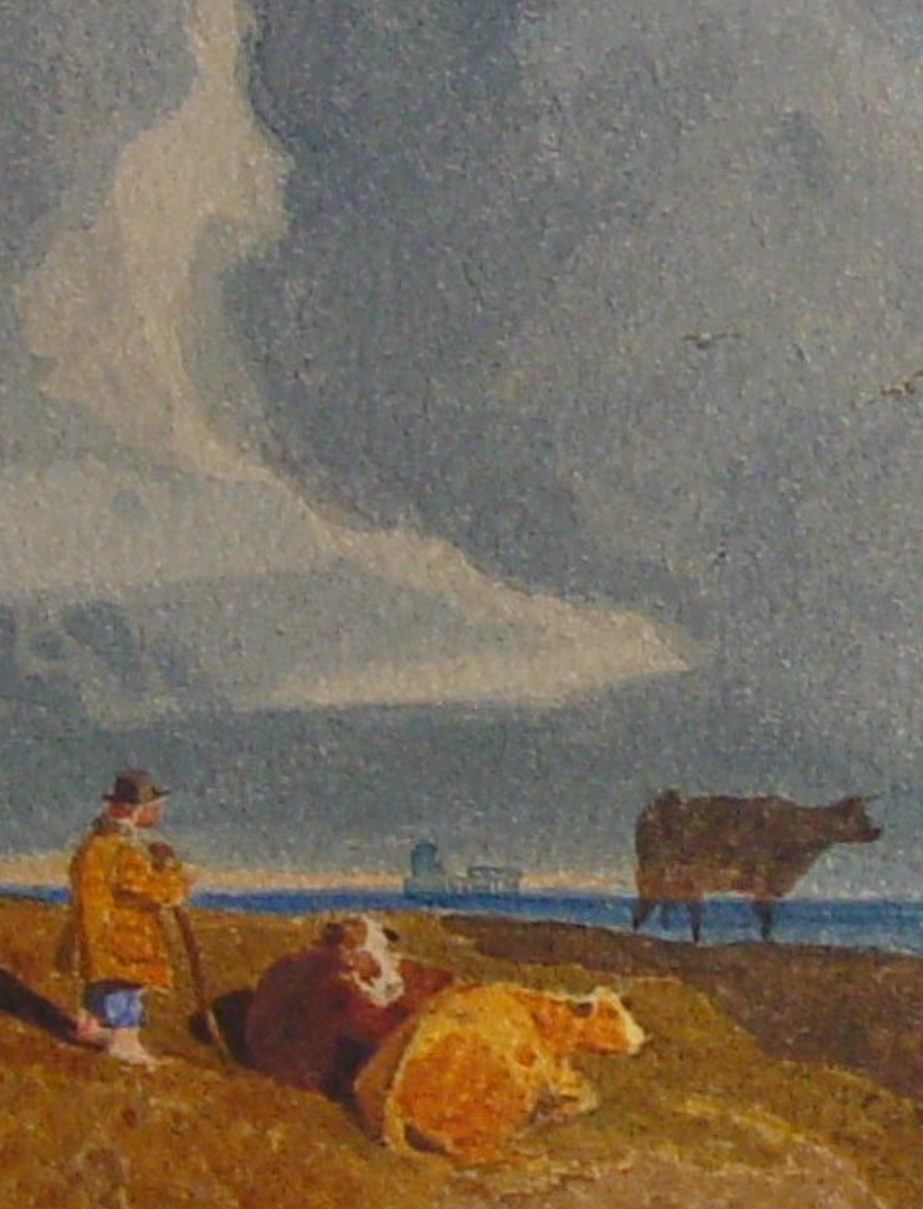
The British Museum’s online catalogue considers this composition at some length, but does not specifically note the presence of Crowland Abbey in the distance. Rather, its description of the subject sets the subject on the coast: ‘Pumping Mill beside a dyke, Lincolnshire; a windmill by the sea, in the foreground cows drinking from a small pond, a herdsman on the sandy bank at left. 1810’. It is understandable that the streak of ultramarine along the horizon might be misinterpreted, but siting the ruins of Crowland on the horizon, was clearly intended to suggest intervening Fenland rather than water.
Mistaking the blue distance for the sea is understandable given the brilliance of the colour. From 1807 Cotman started to experiment with painting. Preparing oil paints for use entailed the buying and mixing of raw pigment, and commensurately with that he became much more frank in expressing the substantiality of his materials in all media. It seems very likely that he would have experimented with mixing pigment both pure and in admixtures across a range of mediums including oils, spirits, gums and gels. Cotman’s work would, I suspect, be especially responsive to further research in this area. Suffice it to say here that the present watercolour represents the climax of a three-year period in which he comprehensively remade his practice, and produced some of the most material watercolours ever put before the public. His Norwich audience can never before have been confronted with such frank, saturated colour arranged into shapes and silhouettes of such uncompromising definition. It is almost as if a Fauvist had been teleported into East Anglia three-quarters of a century early.
To be continued:

 Sublime Sites