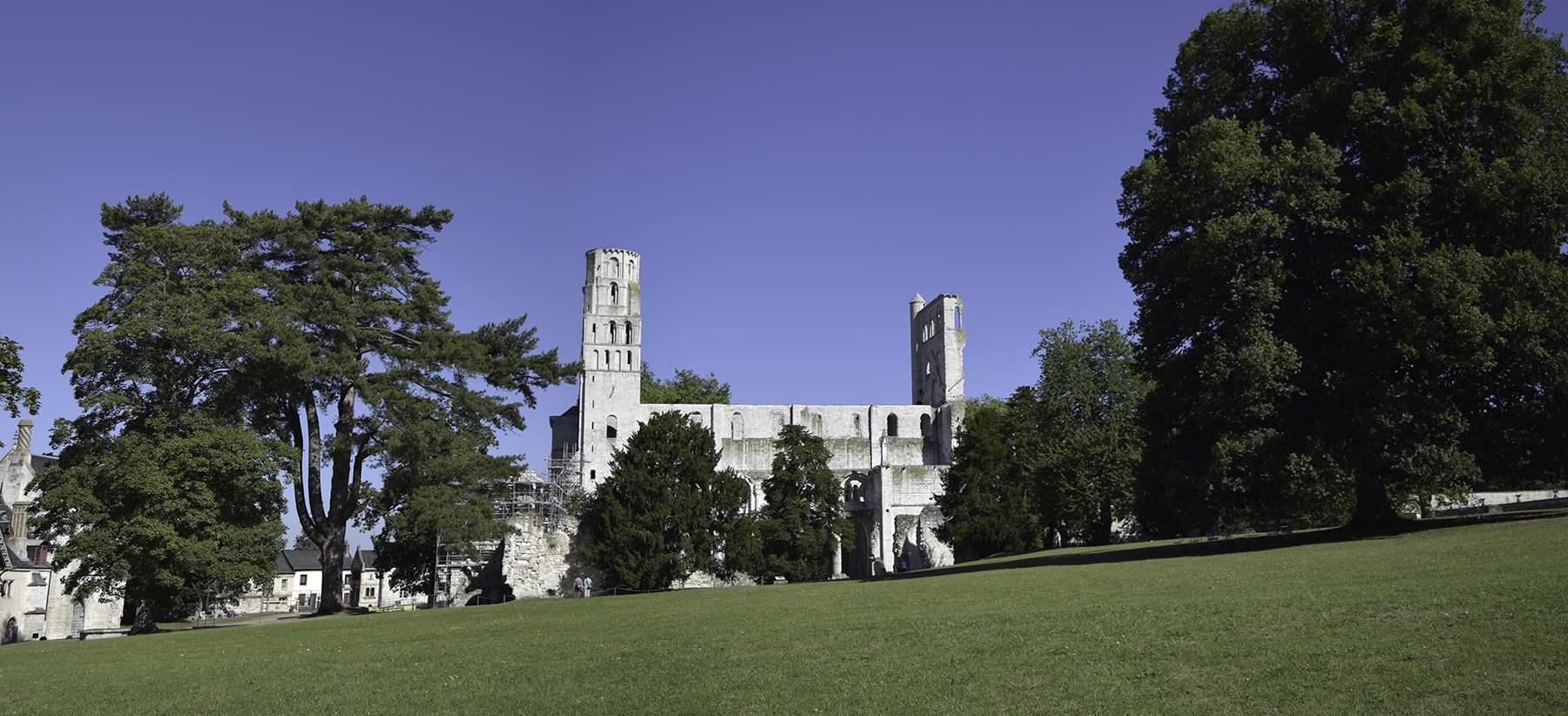
Photograph by David Hill taken 7 September 2016, 10.55 BST
This is the second part of an exploration of Jumieges in Turner’s footsteps. Here we introduce his pencil sketches.
Right click image and select open image in a new tab. Close tab to return to this page

Best viewed full-size
The Romanesque abbey of St Peter of Jumieges sits in a large loop of the river Seine about 12 miles west of Rouen. The abbey itself was founded as early as the seventh century, but was destroyed by Vikings in the ninth and rebuilt by the Dukes of Normandy in the tenth and eleventh. Enlarged in the thirteenth, the abbey survived until the French Revolution when it was closed and pillaged. By Turner’s day it was an established tourist attraction, and its remains being actively preserved for posterity.
Right click image and select open image in a new tab. Close tab to return to this page

Best viewed full size.
Turner made two sequences of sketches on separate visits to Jumieges. The first is in the Tancarville and Lillebonne sketchbook (TB CCLIII) and another in the Seine and Paris sketchbook (TB CCLIV). Both sequences record views of the abbey from the river taken from a boat – probably a steamer – and he does not seem ever to have taken the opportunity to explore the abbey on foot. The closest approach of the river is about three-quarters of a mile to the west. The sketches are all relatively hasty notes, taken at rapid intervals along the westward side of the meander. On board a steamboat, Turner would have been pressured into almost continuous note-taking of the shifting perspective.
Right click image and select open image in a new tab. Close tab to return to this page

Viewpoints in Turner’s Tancarville and Lillebonne sketchbook
Best viewed full size
The Tancarville and Lillebonne sketchbook is dated c.1829 in the Tate’s online catalogue of the Turner Bequest. Caroline South’s introduction to the sketchbook reviews various dates that have been proposed over the years but the current understanding is derived from Ian Warrell’s foundational study of Turner on the Seine (Tate, 1999). Correspondence documents that Turner did make a trip to Paris in that year. He was in London on 11 August and back by 9 September, and he corrected the proof of an engraving that he received in Paris on 21 August. There is nothing definitive, however, that connects this sketchbook to that visit, no sketches of Paris itself, and no other sketchbooks currently associated with the same tour.
The book contains a sequence of sketches made along the Seine between Le Havre, where the river meets the sea, and Poissy about 20 miles west of Paris. The general consensus following Warrell is that the sequence records a journey up river from Le Havre towards Paris. On the evidence of the sketchbook alone, however, it would be equally possible for Turner to have travelled in the opposite direction.
Right click image and select open image in a new tab. Close tab to return to this page
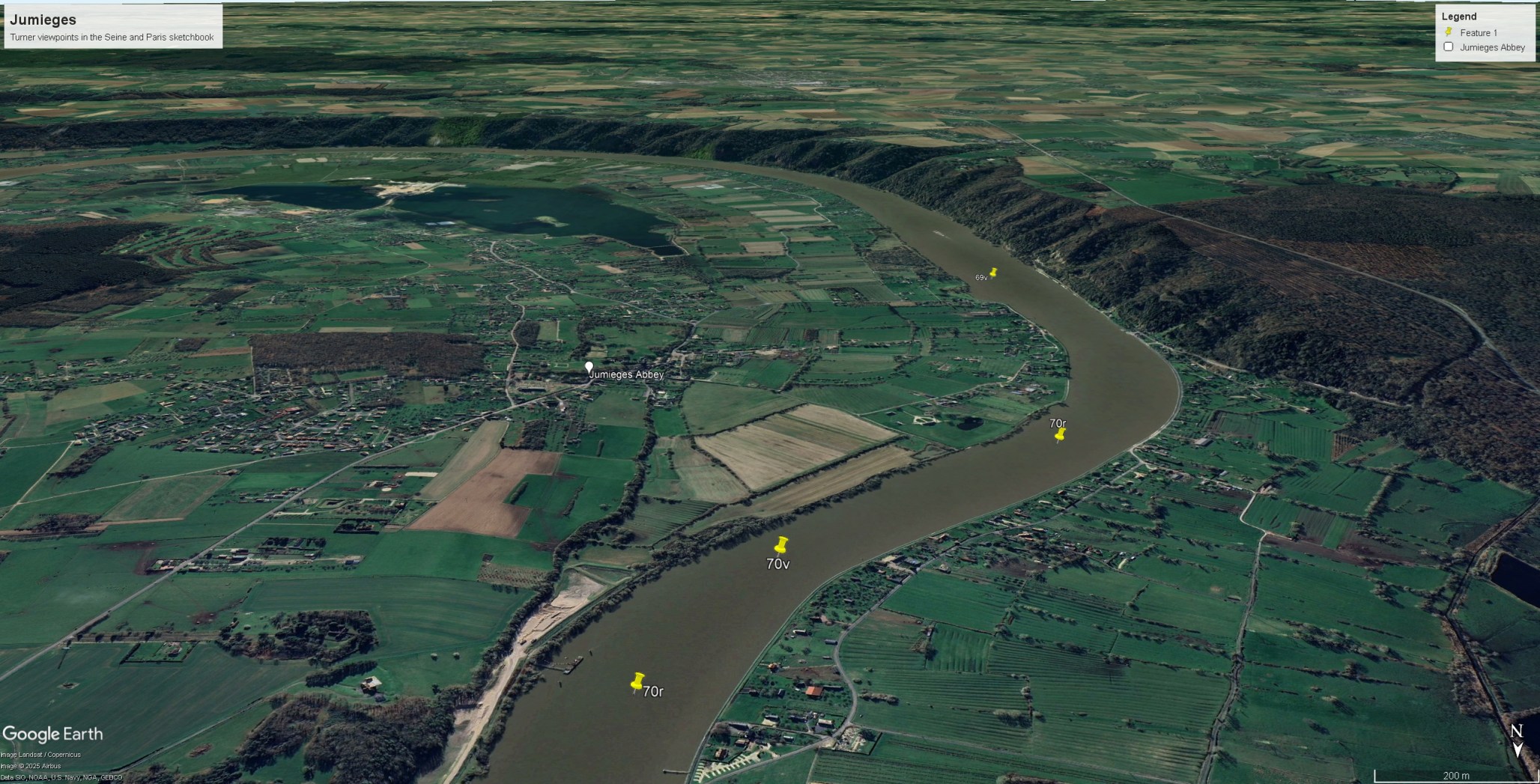
Viewpoints in Turner’s Seine and Paris sketchbook
Best viewed full size
Turner made a second series of sketches at Jumieges in the Seine and Paris sketchbook (TB CCLIV). The Tate’s online catalogue of the Turner Bequest dates this to 1832 again following Ian Warrell. In that year Turner left London sometime after 17 August with the principal objective of completing his sketches on the Seine in connection with intended illustrations for Turner’s Annual Tour. The sketchbook also contains detailed research in Paris in connection with a series of illustrations for Sir Walter Scott’s Life of Napoleon. Agreement about that with the publisher Robert Cadell appears to have been reached only after Turner reached the French capital. Cadell recorded receiving a letter on 14 September from Turner in Paris, so the date of the sketchbook appears well founded. He stayed on until the last week of October, so the sequence of sketches moving along the Seine to Paris, then collecting subjects for the Life of Napoleon, also seems solid. Oddly, Turner repeated almost exactly the same subjects as on the first visit. The relationship between them is so close as to be worth examining the sketches side by side.
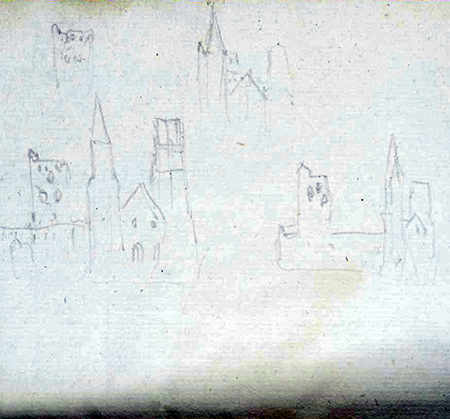

 Sublime Sites