This is the fourth part of an exploration of Jumieges in Turner’s footsteps. In the previous part we traced the viewpoints of his pencil sketches. Here we begin to examine his watercolours.
Gallery of details. Click on any image to open full-size. Close gallery to return to this page.


Turner made three watercolours of Jumieges on blue paper, one of which was engraved for Turner’s Annual Tour published in 1834. These belong to a large group of watercolour studies on blue paper made in connection with his explorations of the rivers Loire and Seine. Of these, sixty-one Seine subjects were engraved and twenty-one of the Loire. The engraved subjects vary in degrees of elaboration and despite the efforts of Ian Warrell and others, many remain unidentified. The situation is further complicated by the fact that there is an almost equally large number of blue paper studies in pencil or in pen and ink. Most commentators have assumed that the blue paper watercolours are derived from the pencil sketches in the sketchbooks (see part #2) but that is plainly not so in many cases, and the pencil studies seem ipso-facto to have been done on the spot. There is a major topic here for further research, but for the time being we may at least assess the material relating to Jumieges.
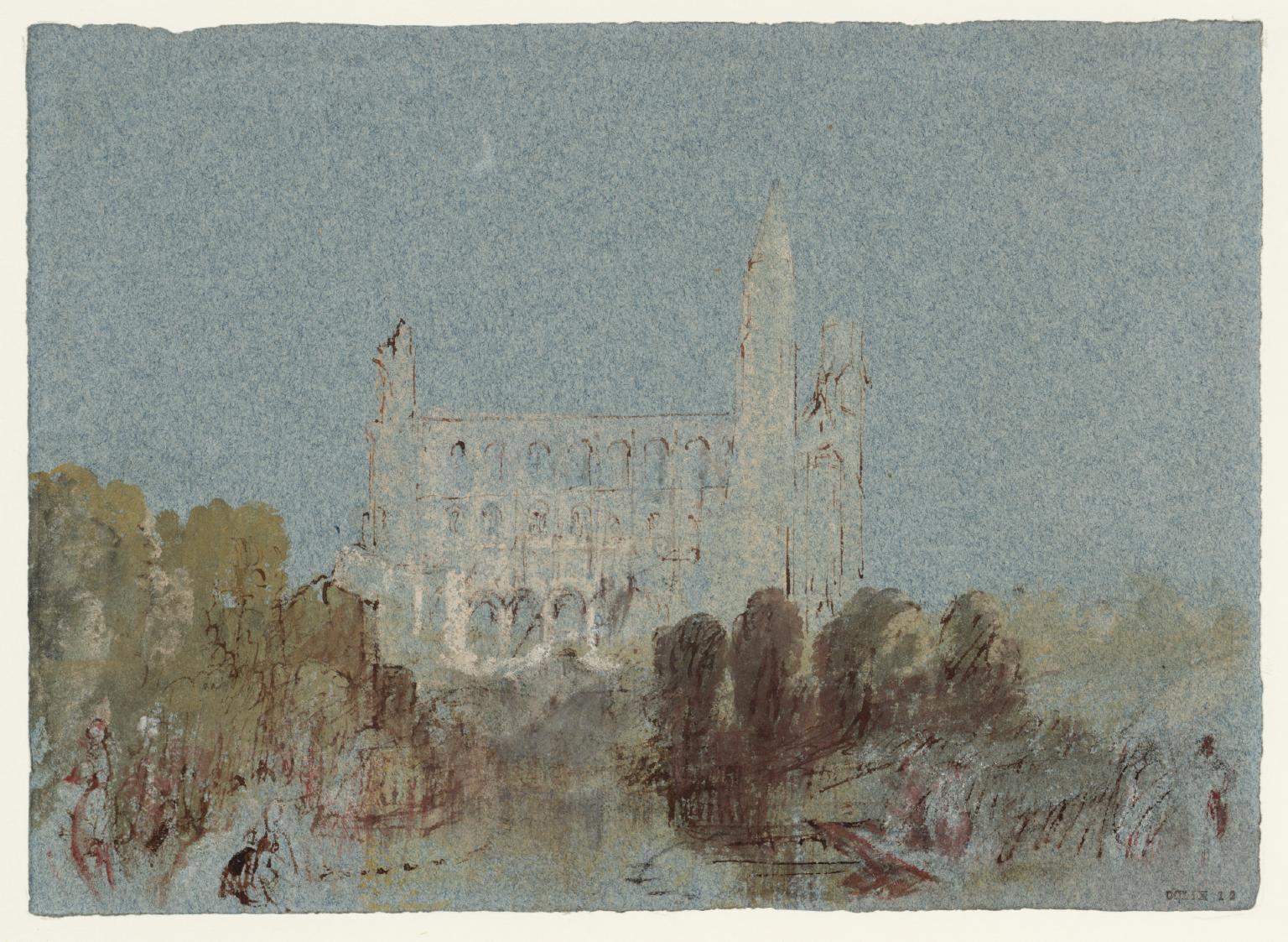
Jumièges Abbey from the north-north-west, c.1832
Tate, London, TB CCLIX 12; Tate D24577
Image courtesy of Tate:
https://www.tate.org.uk/art/artworks/turner-jumieges-abbey-normandy-d24577
If we consider the watercolour studies in the same order as we did the pencil sketches, travelling upstream along the western arm of the Jumieges meander, the first subject is an apparently close-up view of the abbey from the north-north-west (above). Turner made at least five detail studies of this aspect of the abbey, two in the Tancarville and Lillebonne sketchbook (ff.60v and 61r) and three in the Paris and Seine sketchbook (one on f.70v and two on f70r). None amounts to more than a quick outline, but that in the Paris and Seine sketchbook f.70v, gives some hint of the nave fenestration.
Gallery of sketches. Click on any image to open full-size in gallery view. Close gallery to return to this page.

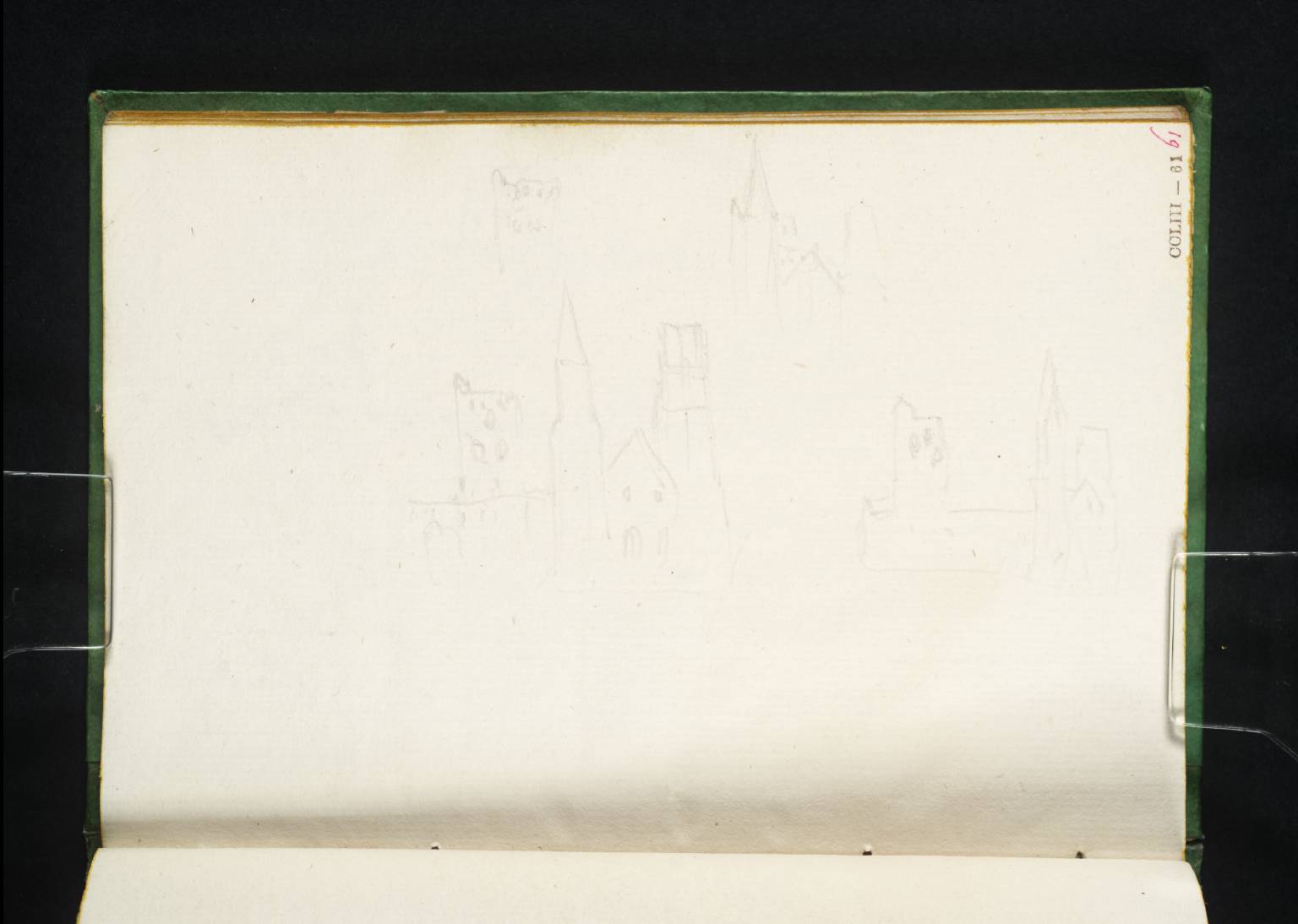


The watercolour appears dependent on none of the above. Even though TB CCLIV 70v (above) counts the clerestory windows (8) and the watercolour has the same number, the differences in detail are more striking. Turner completely alters the proportions. In reality, and in all the pencil sketches, the nave walls rise to less than half the height of the towers. None of the sketches record any detail of the nave openings below the clerestory. In fact, quite unlike the watercolour, the north side of the nave is mostly solid.

Photograph by Professor David Hill taken 7 September 2026, 10.44 BST
Note relatively solid construction of north side of nave
There are small pairs of round-headed lancets at ground floor level, but above that the walls are solid up to the clerestory.
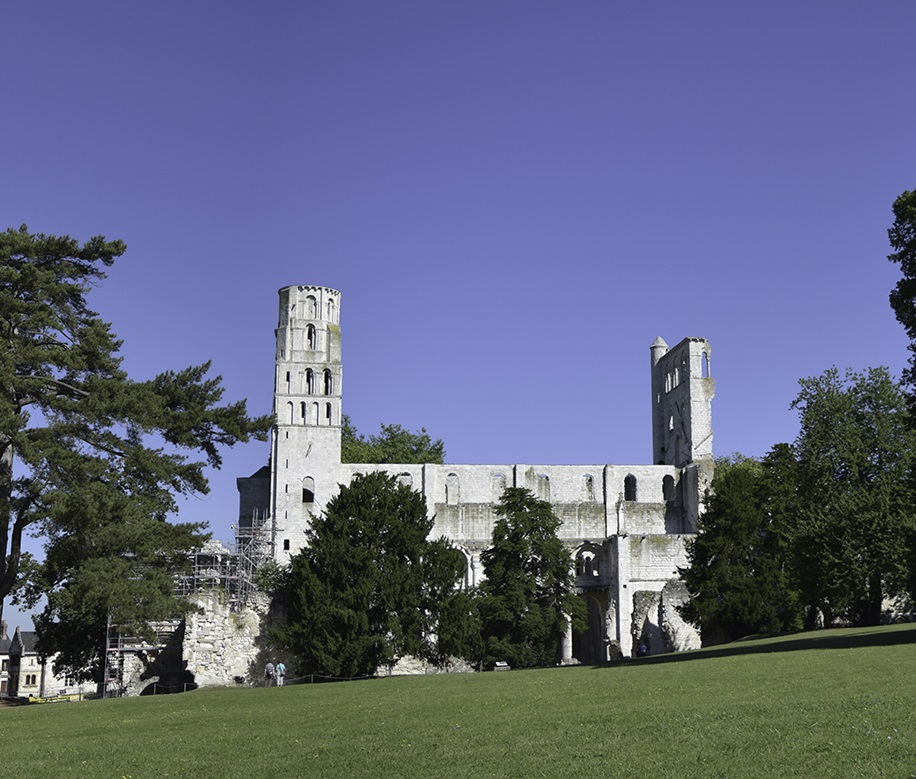
Photograph by Professor David Hill taken 7 September 2026, 10.55 BST
The south side, we might admit, is more comparable to the open structure shown here, but Turner made no drawing that records any of that detail. Quite apart from the body of the church, this composition lacks consistency of viewpoint, even of the parts that do bear any resemblance to the fact. The wall of the crossing is seen from the north (in its thinnest profile) but the west from end is seen from the north-west. It seems remarkable that Turner drew no fewer than five studies of this NNW aspect – at least in so far as he could see anything of it at all from the river – but then chose to ignore all that and work entirely from memory and imagination.

Jumièges Abbey from the north-north-west, c.1832
Tate, London, TB CCLIX 12; Tate D24577
Image courtesy of Tate:
https://www.tate.org.uk/art/artworks/turner-jumieges-abbey-normandy-d24577
In any case the pencil sketches rarely record anything phenomenal or circumstantial. Sometimes Turner set down effects direct from nature, often in very broad terms. Here, he sets down an effect of evening light raking across the north elevation. Given that the main axis of the church is aligned some 10 degrees south of west, it would be possible to see such an effect on any sunlit evening through the summer between the equinoxes. He might even have seen a new moon following the sun to its bed, if that is not just an accidental mark in the sky above the nave, but certainly not in this position in the sky. Here it is set due south, where it could only appear in midwinter. Perhaps he also saw figures at work by and on the river, as he suggest here, but nowhere does the river approach so closely as imagined here. Turner stored up incidents and effects constantly. No-one ever had such a store of such materials, and no sheet could come under his hands without that store pouring onto it. On the other hand, it is remarkable what licence he was prepared to give that process in the French Rivers series. More so, I think we can claim quite fairly, than in any previous topographic series, and perhaps as much, if not more, than in any that came after.
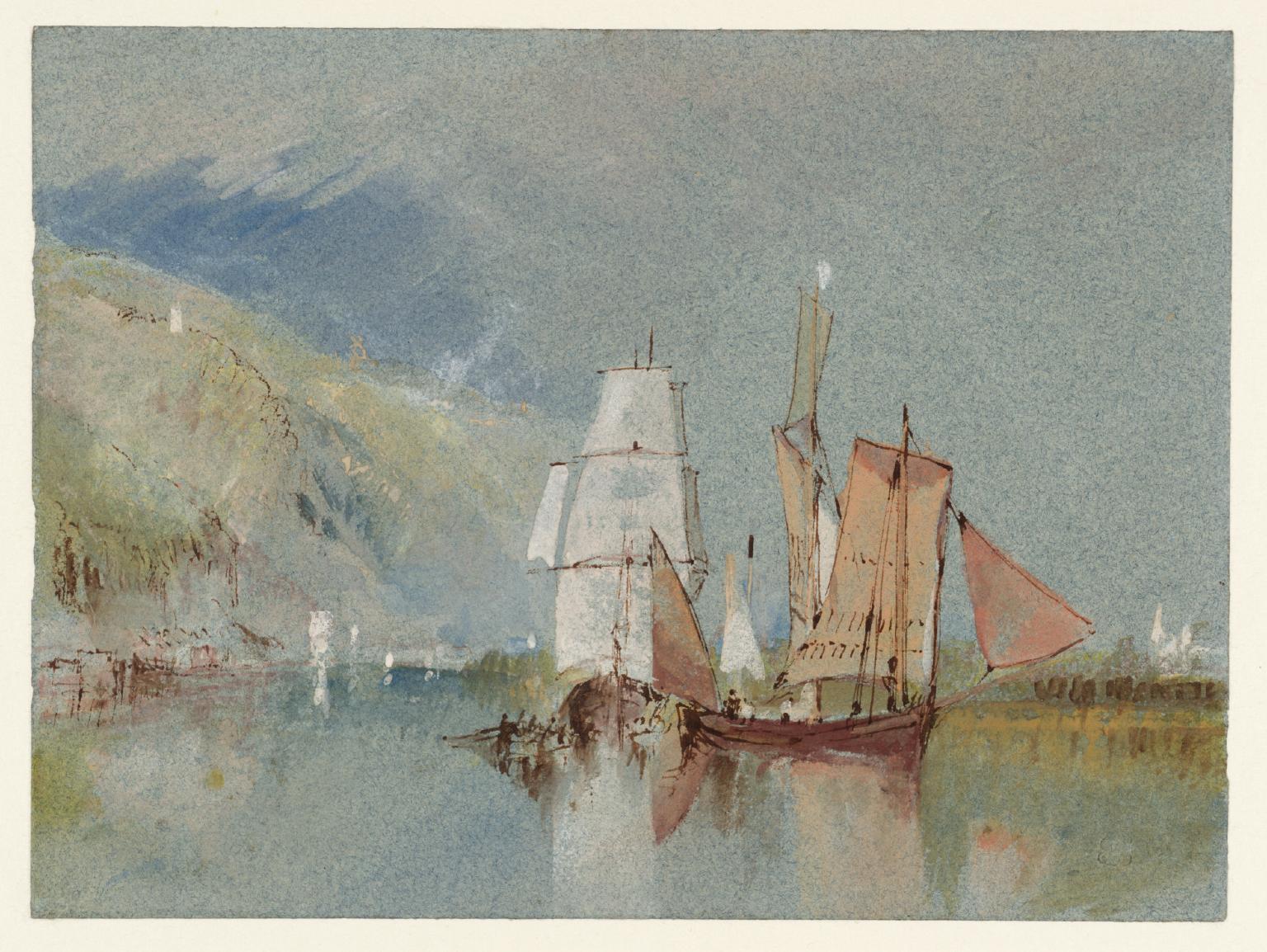
Jumièges Abbey from the south-east, c.1832
Tate, London, TB CCLIX 77; Tate D24642
Image courtesy of Tate:
https://www.tate.org.uk/art/artworks/turner-shipping-on-the-seine-near-jumieges-normandy-d24642
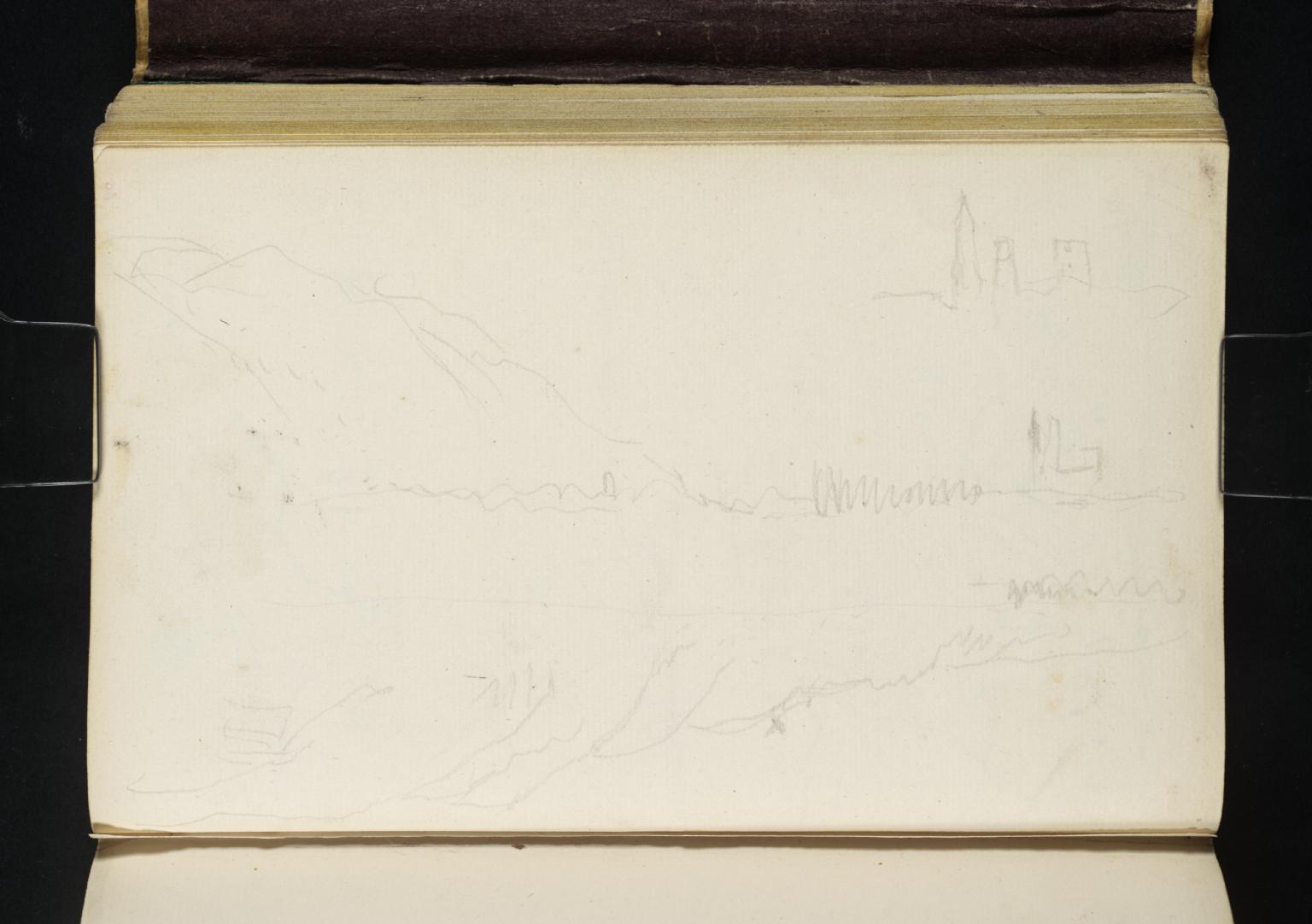
The second watercolour is a study of shipping on the river, with some licks of white paint at the left that suggest a distant view of Jumieges Abbey. The indications are slight, but we can perhaps make out the north-west tower with its spire to the left, the shorter south-west tower to the right, and the gable of the west front between them. We might wonder where the crossing tower might be, possibly just out of frame to the right, but in general we can infer a viewpoint to the south west, and there is a close general similarity between the indications here and the pencil sketches of this stretch of the river in both sketchbooks TB CCLIII 61v and TB CCLIV 69v, particularly with the latter. The correspondence is close enough for the later to have provided a basis for the watercolour.
Click on any image to open full-size in gallery view. Close gallery to return to this page.

Turner has dramatized the height of the left bank, but his principal innovation is the introduction of the shipping. The handling suggests quite animated conditions, with the sun slanting in over our left shoulder. One might at first think of blustery, fitful weather, full of passing showers, except for the fact that the ships are clearly struggling for any breath of wind. The vessel in front to the right is a three-masted ketch, flying just about every square yard of canvas that it can hoist. But for all that there is barely any pressure on the sheets.

Beyond is a somewhat larger brig, again with all every sail up, and even a supplementary hanging to starboard. The sheets catch a vague hint of air, but the only reason it is making any progress against the current it because it is being towed by two rowing boats. It is making better progress than the ketch, however, and is being gently manoeuvred to pass on the outside. The oarsmen will not want to cross too far to the outside of the bend. Not only is that the longer route, but the current is always faster there.
The struggles for wind seem odd in circumstance where some weather does appear to be occurring. But as Turner, an experience sailor, albeit of small boats on the Thames (see my Turner on the Thames, 1993), would have appreciated, the specific difficulty with this particular stretch of river is that it is almost completely enclosed by steep banks, and so almost completely sheltered. Skippers of sailboats must have dreaded it, and looked enviously at the steamboats that could chug up and down without the slightest concern for the wind.
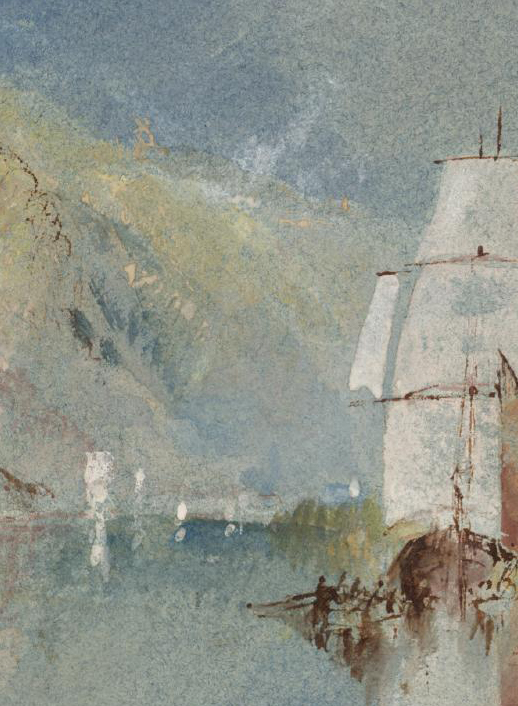
There is one other telling introduction into this watercolour, of a windmill at the top of the wooded slope. There is no windmill in either of the sketches looking downstream, but, as we have previously observed, both sketches of looking upstream on these same page, centre on a windmill overlooking the river. There was an obvious reason for their being situated on the crest of the slope, and that was its exposure to whatever wind that might be available. Its introduction into the watercolour adds a wry touch, allowing it to mock the sails struggling below.


 Sublime Sites