This is the fifth part of an exploration of Jumieges in Turner’s footsteps. In the previous part we examined two of the three watercolours on blue paper that Turner derived from his observations. Here we turn to the third subject, which was selected to be engraved for the second volume of Turner’s Annual Tour published in 1834.
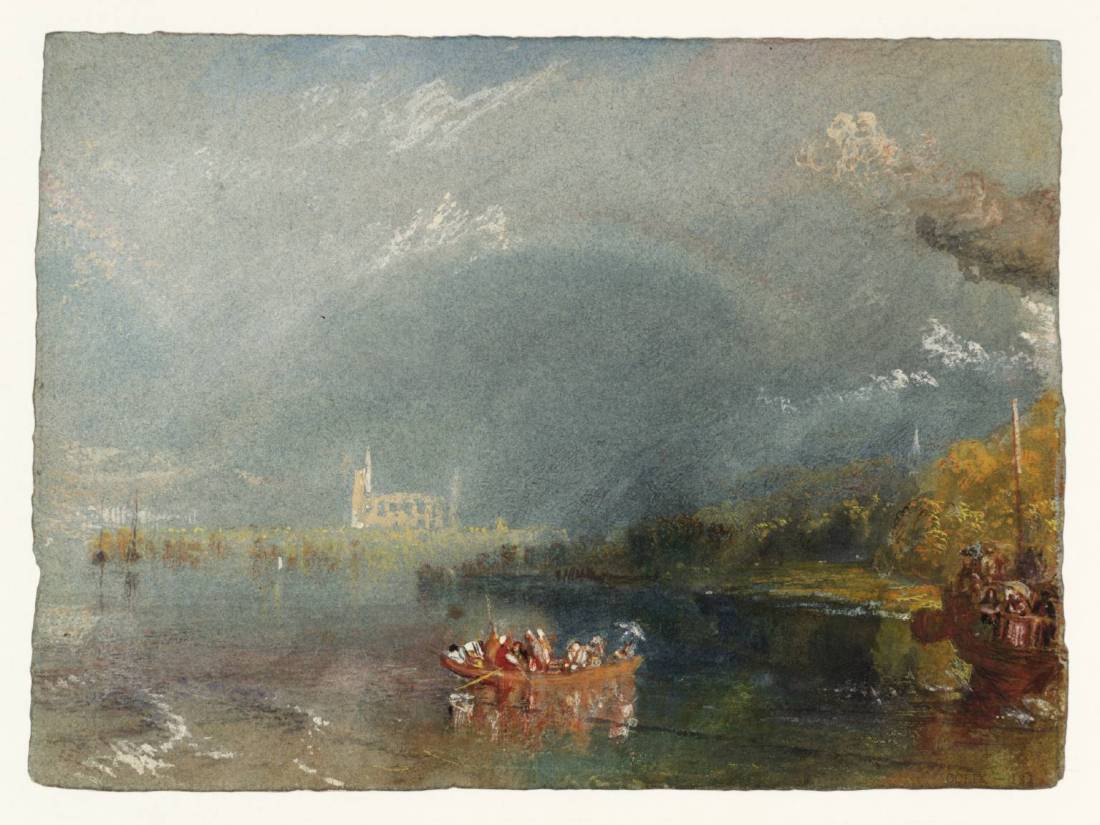
Jumieges
Watercolour and bodycolour on blue paper, 140 x 190 mm, 5 1/2 x 7 1/2 ins
Tate, London, Turner Bequest TB, CCLIX 131
https://www.tate.org.uk/art/artworks/turner-jumieges-d24696
Surprisingly perhaps, given that this is the subject selected for engraving, this is the most difficult of the Jumieges watercolours to elucidate in terms of its topography. The form of the abbey is rather dashed-in but the north-west tower with its spire appears to the right of the shorter south-west tower. This establishes a viewpoint on the river slightly to the east of due south. Any such viewpoint would be over three miles distant. Google Earth has a streetview panorama by Edward Tap taken from the Belvedere de Barneville sur Seine – and even from such high ground at the edge of the escarpment the abbey is but a couple of specks. The distance implied by the watercolour is clearly much less than that, so must be imaginary. The river appears to pass to the right of the abbey instead of the left. Nor, in any view from the south is there any rising ground on the right bank of the river such as that depicted here, still less any church spire that might appear above the trees.
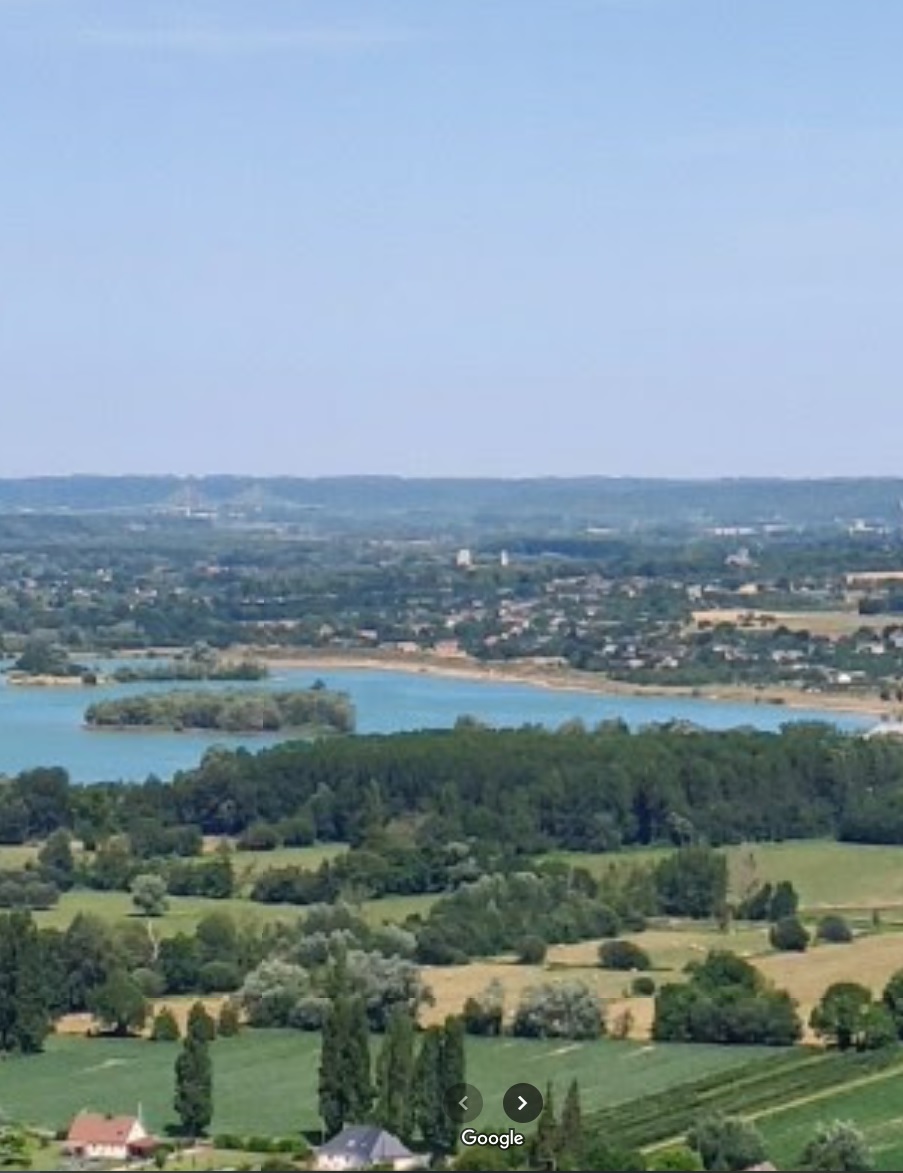
Detail of Google Earth streetview panorama by Edward Tap
Original at
https://maps.app.goo.gl/bCzKqnGwtgamkJHL7
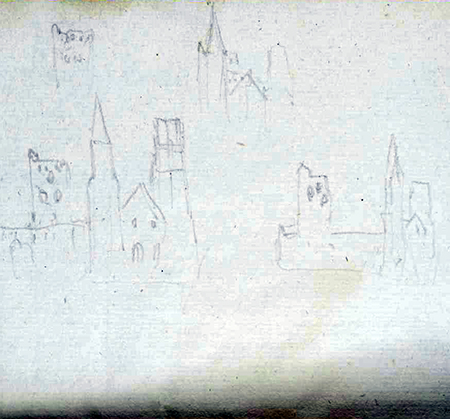
None of the pencil sketches have any close relationship to the watercolour. In his 1979 catalogue of Turner’s watercolours (where Jumieges is listed as no.961) Andrew Wilton asserts that it is: ‘Based on a pencil drawing in the Tancarville and Lillebonne sketchbook (T.B., CCLIII – 59v)’, but as we saw in part #3, this is actually a view from the north and there are no specific points of compositional similarity. Warrell 1999 was the first to identify the viewpoint of the watercolour as a view from the south, and found no exact counterpart in a sketch (cf cat. no 127. p.275). The nearest, Warrell observed, is the sketch in the Seine and Paris sketchbook, TB CCLIV 69v, but that is taken from much closer and to the south west, and as we saw in part #4, relates most closely to the colour study TB CCLIX 77.
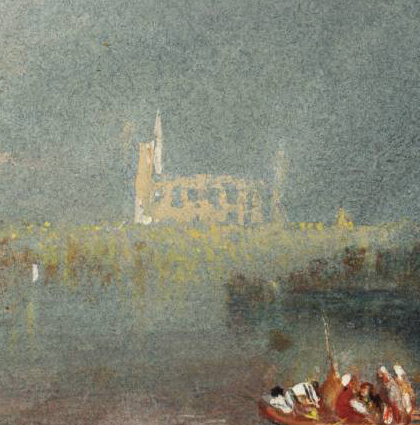
It would appear that Turner composed the watercolour entirely from memory. After Leitch Ritchie visited Tuner’s sites in order to write the text for Turner’s Annual Tour he recalled: ‘I was curious in observing what he made of the objects he selected for his sketches, and was frequently surprised to find what a forcible idea he conveyed of the place with scarcely a single correct detail’. Jumieges is perfect illustration of the truth of that assertion. Not a detail is correct, yet somehow the watercolour does manage to characterise the place very well.
It is perhaps worth giving some pause to wonder how Turner carries this off. He salvages sufficient recollection of the distant prospect of the abbey to render it recognisable and he remembers the sweeping bend of the river, wooded banks on one side, flat ground on the other. This rather begs the question of what we truly remember of anywhere. Nowadays we tend to let photographs do the work for us but our native memory tends to be anything but scopic. It is fragmentary, coloured by feeling, circumstantial, subjective and idiosyncratically selective. Before photography (stirring into being in the 1830s, but not widely established until the 1840s) it must have been rare to hold up an image before its supposed site. When Leitch Ritchie explored the Loire and Seine to make his notes for Turner’s Annual Tour he did so armed with a packet of proofs of the engravings. As Ian Warrell points out (Turner on the Loire, 1997, p.194) he was thus one of the very first to so travel In Turner’s Footsteps.
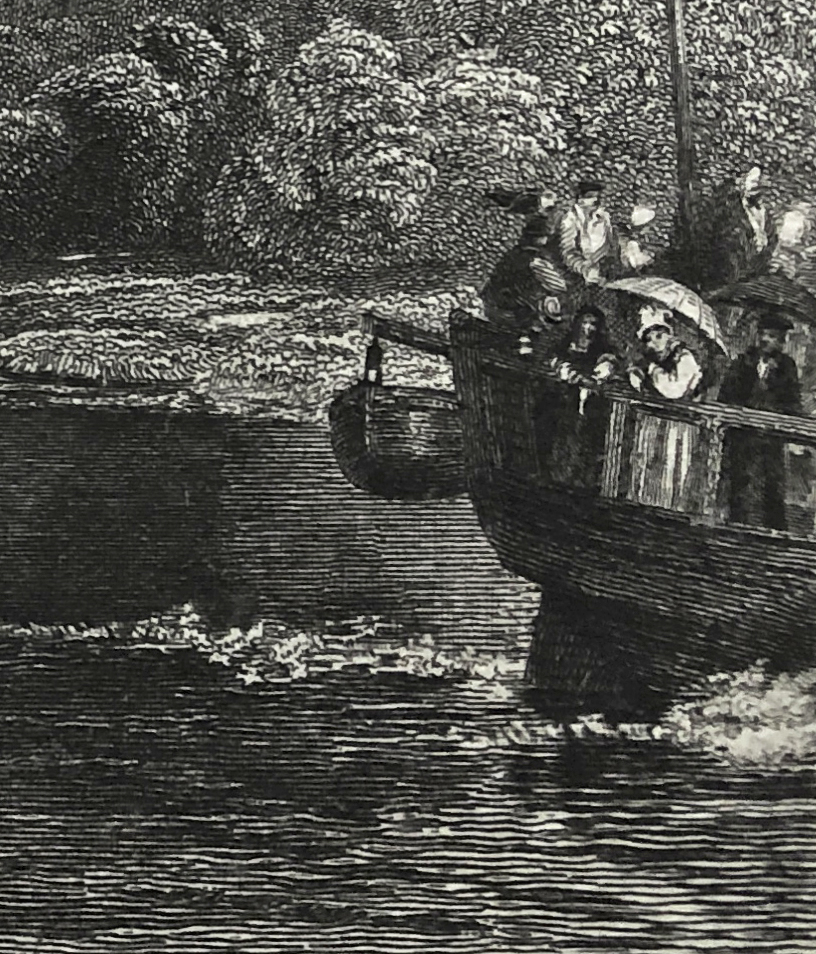
From our examination of the pencil sketches it emerged that on both his visits Turner’s experience of Jumieges was conditioned and constrained by his being confined to a passing boat. As Warrell also observed he was never afforded the opportunity of making a study of the site from a static, grounded, viewpoint.
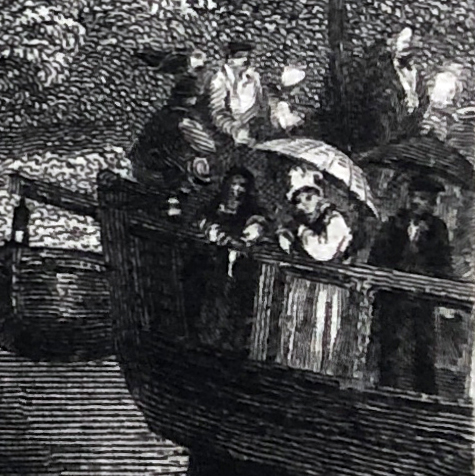
Turner’s sketches seem to express a sense of constraint, and alienation, at least from the pedestrian modes of exploration to which he was generally accustomed. It seems relevant that in the introduction to the third volume of Turners Annual Tour, Leitch Ritchie criticised the quality of experience offered by the steamboat:
‘For a short period in summer, it is possible to travel from Rouen to Paris by a passage steam-boat on the Seine: the voyage, however, is long, and not always pleasant. Our eyes, accustomed to the magnificent panorama presented by the lower part of the river, become discontented even with beauty itself; the towns, villages, and castles, flit past us like shadows, and carry away with them, like shadows, their historical associations; till, by the time we reach our destination, we heartily regret having forsaken the moral world of the past and present, for the cold, dead face of external nature.// For our part, we hate to be stuck, like one of its masts, in a river-bat, and with no greater faculty of volition. Give us the firm land for our wandering foot, and let us feel that we are free denizens of the earth! Give us the rock for our seat, the forest for our shade, e mountain-top for our temple, the city for our theatre – were we may laugh and weep, when we are in the vein, at the tragi-comedy of life! But, above all, let change be at our command; and let us feel, in gazing at rock, forest, mountain, or city, that wherever our fancy leads us, ‘We have the passion and the power to roam!’.
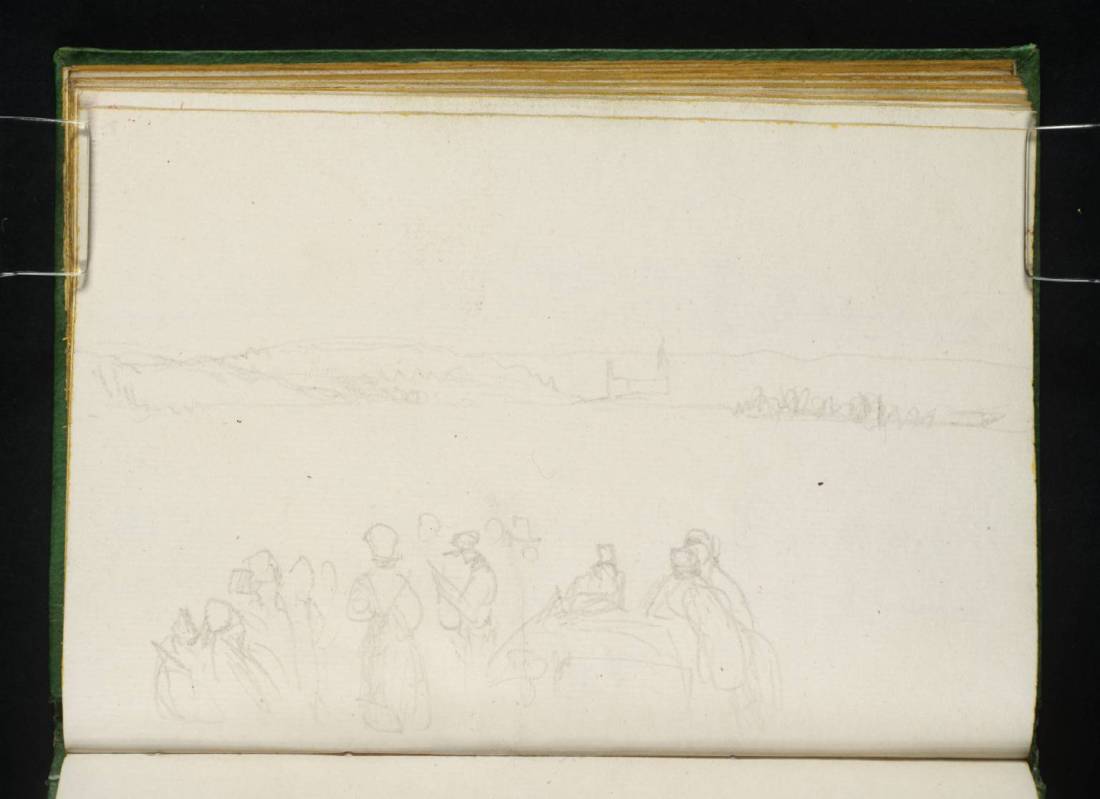
Turner seems to have begun musing on this issue in his very first sketch (TB CCLIII 59v) , viewing Jumieges over a group of fellow passengers, all craning for a view of the next landmark. It seems implicit that the whole experience is passive in its nature, and restricted in the agency it allows to its consumers. The package tour era was beginning, though it appears that Turner was more than a little ambivalent about its benefits.
To be continued:-

 Sublime Sites