This is the twenty-second article in a series cataloguing John Sell Cotman’s first series of etchings published in 1811. Here in plate 19 Cotman continues with his Yorkshire material, and selects one of the county’s major historical landmarks. As at many of his sites in this series, he leads us to not to any of its highlights, but rather into one of its more obscure corners.

Fountains Abbey, Yorkshire, 1811
Private Collection
Photograph by Professor David Hill
This is an upright architectural subject featuring an oblique view from the left of a range of three tall lancet windows. There is a small round-headed door to the right and a fourth lancet to the left, mostly obscured by vegetation. A solitary male figure sits on a bank in the foreground, a staff resting over his shoulder, and overhead flies a heron, or possibly a stork.

The plate was etched by Cotman and dated 30 April 1811 for his first series of ‘Etchings by John Sell Cotman’. This was issued to subscribers in parts, and the present subject was published as plate 19 in the complete edition of 1811. The previous plate, Kirkham Priory (plate 18) was published on the same day, and together they comprise the nineteenth and twentieth of the twenty-four subjects published in date order. The plate is well bitten and the print clean and delicate, but the sky seems to want richer tonality to properly balance the composition.
Right click on image to open full-size in a new tab. Close tab to return to this page.
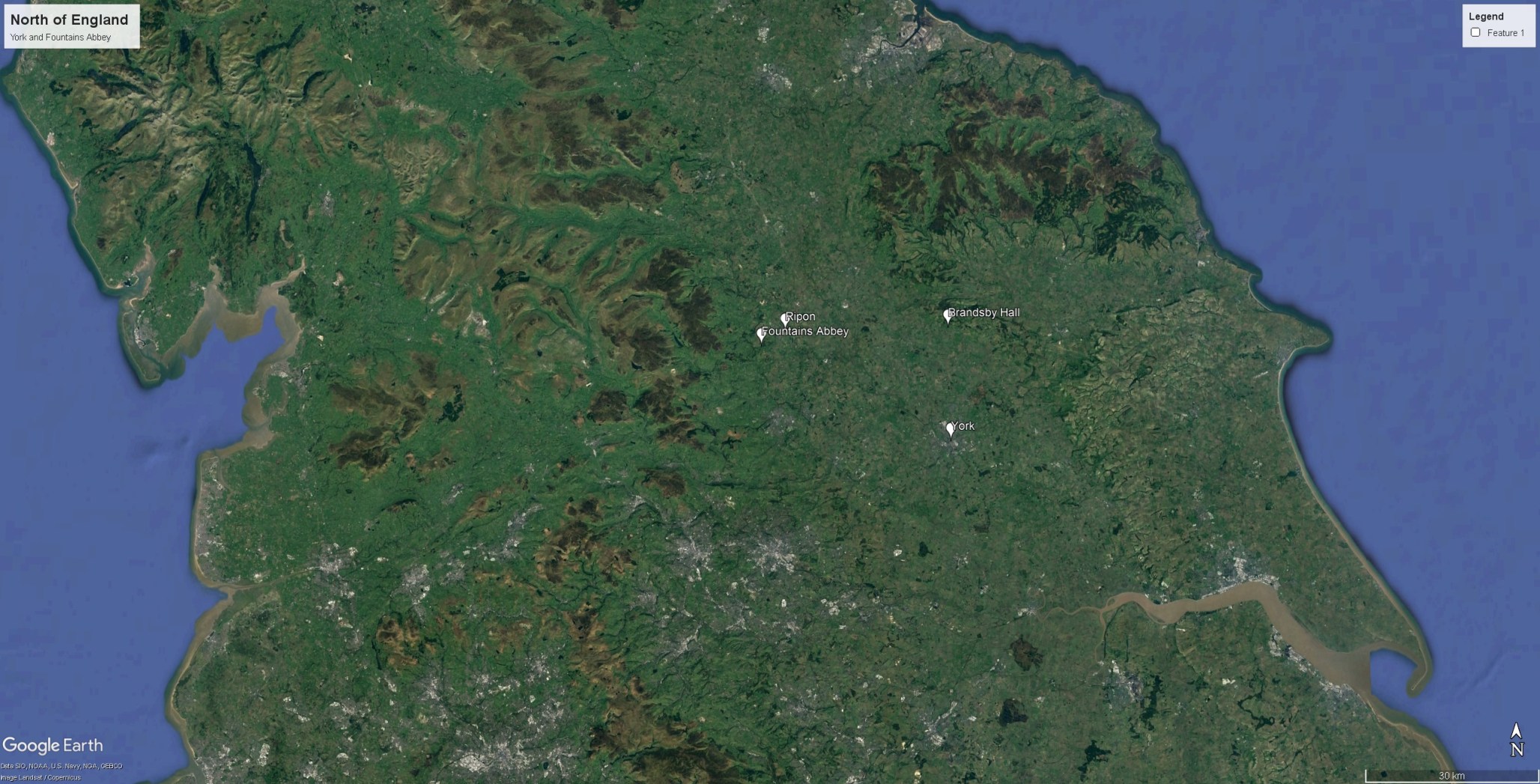
Fountains Abbey is one of the largest, best preserved and well-known monastic sites in Britain. It occupies a sheltered site on the banks of the river Skell, a couple of miles east of Ripon in North Yorkshire. It was founded in 1132 by a breakaway group of monks from St Mary’s in York (see plate 6) monks from York. At its height it owned land stretching from sea to sea across the north of England, and it is said that hardly a single piece of business transaction could take place across the north without a monk from Fountains being involved. During the eighteenth century the ruins were brought into the extensive landscaped water gardens of Studley Royal. The whole site is now designated of World Heritage significance.

Cotman visited Fountains in the company of fellow-artist Paul Sandby Munn, during a tour of Yorkshire in 1803. From 7 July they stayed for a week at Brandsby Hall, the home of the Cholmeley family about ten miles north of York, and on the 14th they set off for a short tour of the county. On the 18th they arrived at Ripon, where they pronounced themselves delighted with nearby Fountains, and resolved to stay on for a week. This gave sufficient time to each fill a portfolio with high-quality drawings, but hardly any on-the-spot sketches survive today. I gave a lengthy review of the surviving works in Cotman in the North, (Yale UP, 2005), pp. 36-39, so to repeat all that here would be an imposition on the reader’s patience.
Click on any image to open full-size in a gallery. Close gallery to return to this page
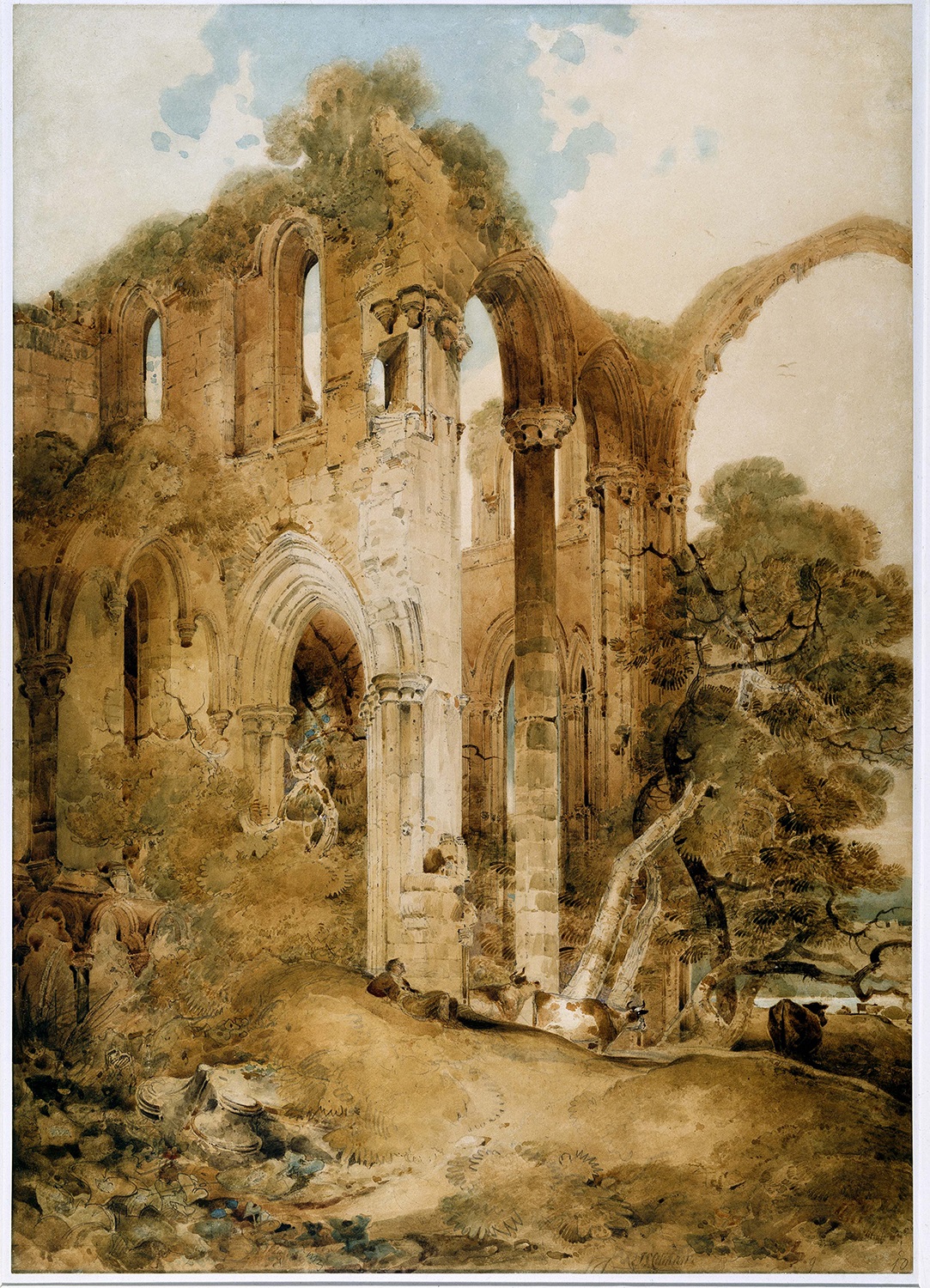
Fountains Abbey: the east end, looking north east from the presbytery, 1804
Watercolour, 33 13/16 x 23 15/16 ins, 859 x 609 mm
Fitzwilliam Museum, Cambridge

Fountains Abbey: the east end, looking north east from the presbytery, 1804
Graphite on paper, 14 1/2 x 10 1/2 ins, 369 x 267 mm
Castle Museum, Norwich

Fountains Abbey: exterior view of the east end, 1804
Watercolour on wove paper, laid down on original mount, 17 x 12 7/8 ins, 430 x 327 mm
Ashmolean Museum, Oxford
Suffice it to say that Cotman made a major investment in Fountains Abbey subjects in the years immediately following his visit. He concentrated on the celebrated east end, and he produced one of the largest and most ambitious watercolours of his career (Fitzwilliam Museum). This must be the work that he exhibited at the Royal Academy in 1804 (no.564 as ‘Fountain abbey, Yorkshire’), and at twenty-two years of age, would have suggested the potential to rival even Turner, who was just seven years his senior. He repeated the composition in a prodigious pencil drawing dated 1804 (Norwich Castle Museum), which would have established him as one of the finest architectural draftsmen of his time, and in the same year developed a large dramatically-lit watercolour of the great east window seen from the exterior that was bought by Cotman’s important Yarmouth patron Dawson Turner, and subsequently found its way to the Ashmolean Museum in Oxford. A summary of the full range of his various subjects is appended as a postscript to this article.
When Cotman selected a Fountains Abbey subject for his first series of etchings, it was with very different intention to his earlier compositions. I have had many occasions on which to point to Cotman’s radical shift in direction after 1805. Until then he forged ahead very much in the Romantic Sublime of Turner, but suddenly swerved away from that to a very much less demonstrative idiom, more ‘Wordsworthian’. This is characterised by an anti-heroic spirit, an engagement with quiet, often sequestered subject matter. His mode of expression is plain but judicious, his focus reductive almost to singularity, and his style undemonstrative almost to the point of reticence.
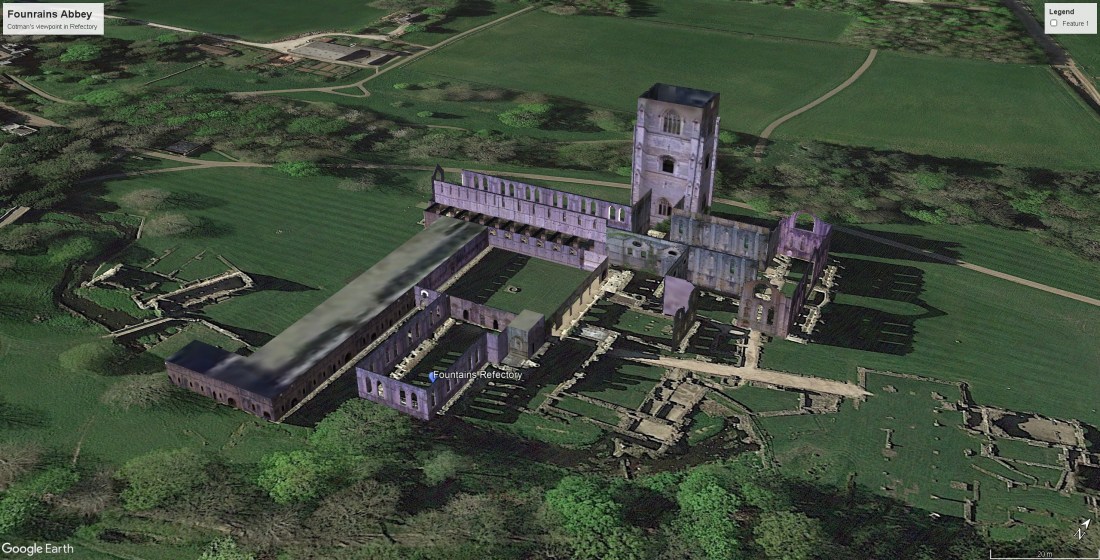
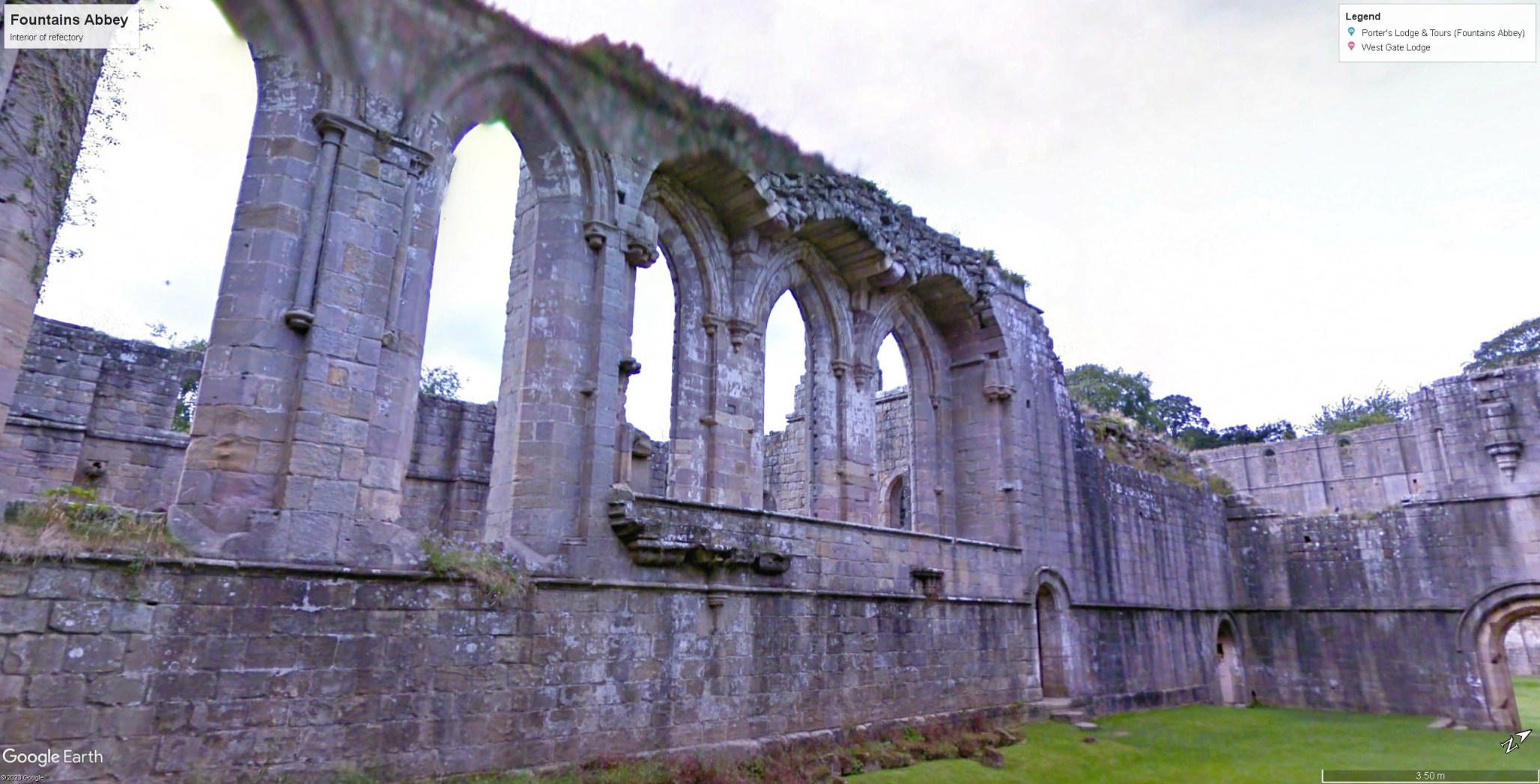
Cotman’s subject is the interior of the refectory. Even today not many visitors venture through the portal; many look in from the cloister, but few find much to draw them in. Cotman found himself a perch towards the far end to take a raking view of the west wall, where a portal gives aces to stairs within the wall that formerly gave access to a pulpitum from which lessons could be read to the monks assembled below. Perhaps not by coincidence Cotman had already etched a similar subject at Rievaulx Abbey (see plate 11).

One may wonder whether Cotman saw some particular significance in the subject. There is an obvious notion of physical and spiritual nourishment being taken together, and perhaps the thought that the latter had fallen somewhat into decay? In any case Cotman must certainly have intended us to wonder at his choice of subject, when there was the wonderful setting the great east end that he had earlier depicted. Rather than seek out the conventional gratifications, he preferred an alternate and sterner subject, yet treated it with attention and diligence nonetheless.

He also includes a figure in the composition, perhaps a guide, sitting patiently attuned to the place. Overhead, we ought to notice, and even consider, Cotman introduces a heron flying. Presumably he intended it also for poetic effect. Herons are patient and attentive birds and have many associations in a Christian context. Microsoft Chat AI provides a good deal to mull over
the heron is also associated with spiritual significance in Christianity. It is often seen as a symbol of resurrection, hope, purity, and chastity 23. The bird’s graceful movements and stillness are seen as a representation of the contemplative life, where one is focused on spiritual matters and is patient in waiting for divine guidance 4.
In addition, the heron is also considered a symbol of personal transformation, wisdom, and independence 2. It is believed that the heron can bring a sense of tranquility to an environment and inspire us to maintain our composure regardless of the demands of our daily lives 25.
There is material here sufficient to weave up several different interpretations, and other references and significances might no doubt be found. Cotman would most certainly not have wanted to tie down the interpretative possibilities. He would, however, have hoped that the viewer might respond with curiosity and interest.

Summary of known states:
First published state
As editioned by Cotman for ‘Etchings by John Sell Cotman’, 1811, where plate 19.
Line etching, printed in black ink on soft, heavyweight, off –white, handmade rag wove paper, image approx. 297 x 218 mm on plate 306 x 227 mm on sheet 474 x 340 mm.
Inscribed in plate lower right in large script, – rather mixed up in background detail: ‘Part of the Refectory of/ Fountains Abbey Yorks’, and below in smaller script: ‘Etched & Published April 30th 1811 by John S Cotman Norwich’.
Collection: Examples in various collections, e.g. Norwich Castle Museum NWHCM : 1956.254.21
Second published state
As editioned by H G Bohn in ‘Specimens of Architectural Remains in various Counties in England, but especially in Norfolk. Etched by John Sell Cotman’, 1838, Vol. 2, series 4, v.
Line etching, printed in black ink on soft, heavyweight, off –white, handmade rag wove paper, image approx. 297 x 218 mm on plate 306 x 227 mm on sheet of ?machine-made heavyweight wove paper, 493 x 353 mm
Plate as 1811 edition except for the addition of inscribed numeral ‘V’ top centre.
Examples in numerous collections, e.g. Norwich Castle Museum, NWHCM : 1923.86.21
References:
Popham, 1922, no.21.
Postscript – other Fountains Abbey subjects by Cotman
Cotman visited Fountains Abbey over the period of a week c.18-23 July 1803. He must have made quite a number of sketches, although none may be identified today with certainty.

Fountains Abbey, the base of Abbot Huby’s tower from the presbytery, 1803?
Pencil and sepia wash, 12 x 8 3/4 ins, 305 x 222 mm
Present whereabouts unknown
One possibility is a watercolour study of the base of Abbot Huby’s Tower which was in the collection of Dr J S Cotman of Reading in 1937, but which is now untraced but was reproduced in Sydney Kitson’s Life of John Sell Cotman published in that year.
In 1804 Cotman produced three major works – two watercolours and a pencil drawing. These are reproduced in the main article above.
The next reference is to an exhibit at Norwich Society of Artists, 1811 no 71 as ‘Part of the Refectory of Fountains Abbey, Yorkshire’. This was almost certainly the etching catalogued in the main article.

Fountains Abbey, the base of Abbot Huby’s tower from the presbytery, c.1811
Pencil on paper, 12 1/2 x 9 1/4 ins, 320 x 235 mm
Present whereabouts unknown
About the same time as the etching he made a pencil drawing of the same composition as the c.1803 watercolour sketch. This was sold at Sotheby’s on 28 November 1974, lot 115, but its present whereabouts is unknown to me. It is reproduced here from a photograph taken at the time of the sale.

Fountains Abbey, the exterior of the South Transept of the Chapel of the Nine Altars, c.1811?
Pencil on paper, 11 5/16 x 8 ¾ ins, 289 cm x 224mm
Norwich Castle Museum, NWHCM : 1951.235.481
Also apparently dateable to about c.1811 is a drawing of the exterior of the South Transept., which forms part of the east end of the abbey church. In style it is somewhat firmer in handling than drawings from about 1811. The great Cotman scholar Miklos Rajnai dismissed it in his seminal catalogue of Cotman’s Early Drawings at the Norwich Caste Museum, 1979, no.29, n.9 as a ‘crude copy’. In any case, the reproduction on Norfolk Museums online makes it seem anything but crude. If a copy this is by a very able student!

Fountains Abbey, the entrance to the Refectory from the cloister, c.1815?
Pencil and watercolour, 9 1/2 x 11 3/4 ins
Untraced
Evidently dating from a little later, perhaps c.1815, is a rather pretty composition in pencil and wash showing the entrance to the Refectory with a girl in a bonnet seated sketching. This is currently only known through a photograph in the Witt Library.
The next references that we have is to two exhibits at the Norwich Society, 1824 (85 as East End of Fountain’s Abbey, York and 90 ‘Arches under the Tower of Fountain’s Abbey, Yorkshire’. The first is described as ‘a specimen ‘from the folios which Mr Cotman dedicates entirely to the use of his Pupils’. This could be the Norwich drawing of the South Transept – which forms part of the great east end, or some version of the 1804 compositions. The second could well be the Sotheby’s 1974 drawing, but that could equally well have been a drawing from Cotman’s folios.
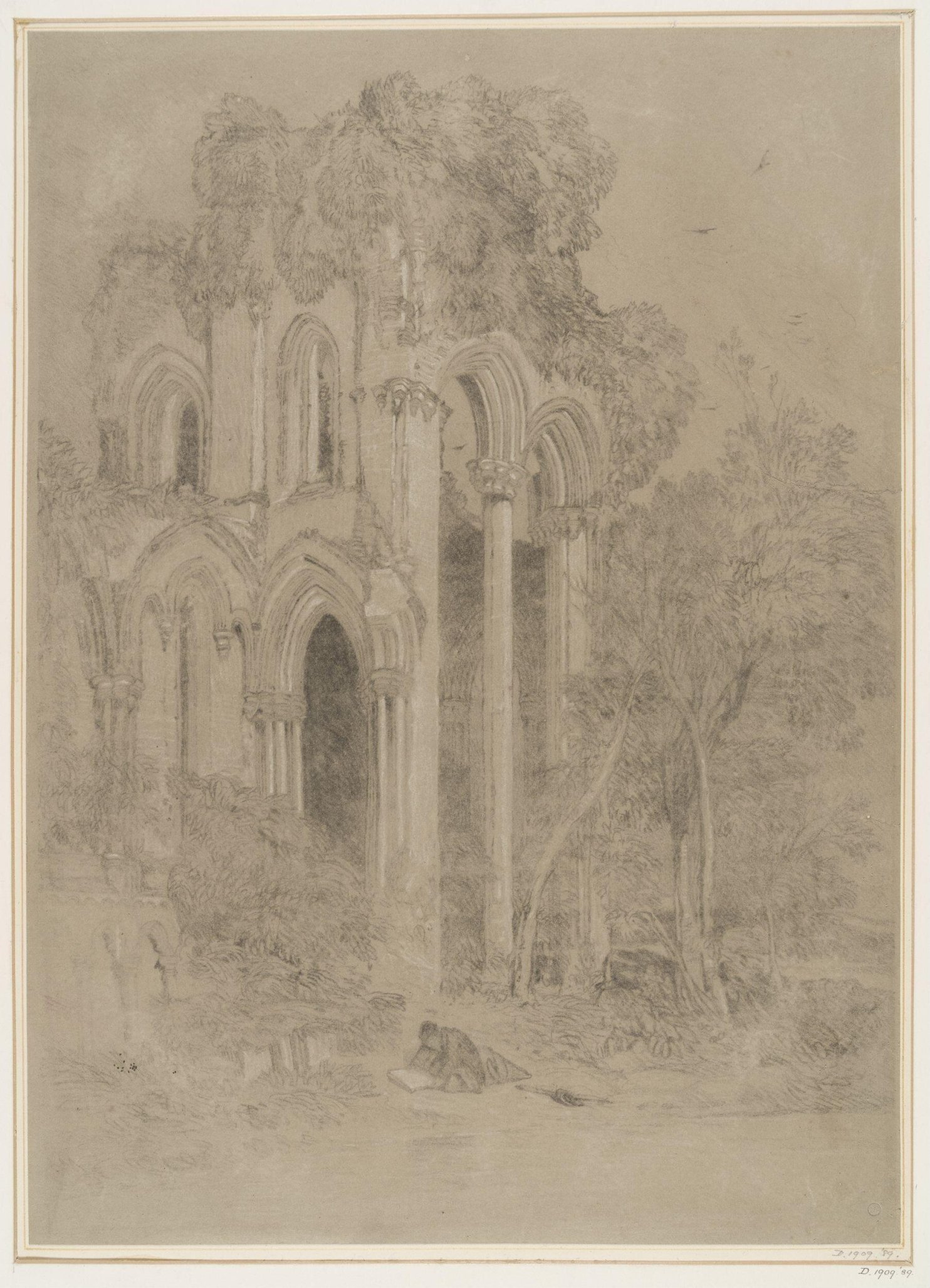
Fountains Abbey, the east end from the presbytery, c.1824?
Soft graphite, black and white chalk on grey/brown wove paper, 445 x 319 mm, 17 1/2 x 12 5/8 ins
Victoria and Albert Museum, London, D1909-1889
The final reference is to an exhibit at the Norfolk and Norwich Art Union, 1839, no. 274 as ‘Fountains Abbey Yorkshire – A Specimen of his School drawing.’ This might well have been one of the drawings previously mentioned but the V&A has a rather fine graphite and black and white chalk drawing on grey/brown paper which is otherwise unaccounted for. This is a restatement of the grand composition of the east end seen from the presbytery that he developed in 1804, but with the great east window omitted. As it survives, the whole surface is rather rubbed, possibly the result of serving time in a portfolio. Whilst still in the possession of Cotman’s son, John Joseph, this drawing was selected by the Department of Science and Art to be lithographed by Vincent Brooks as one of a series of Cotman exemplars that were circulated to the recently established regional art and design schools for the use of pupils. Leeds has a copy of the lithograph.

Fountains Abbey, the east end from the presbytery, c.1860?
Lithographic print on heavyweight, white, wove paper, 437 x 340 mm
Leeds City Art Gallery 1949.813

 Sublime Sites