This is the thirtieth article in a catalogue of John Sell Cotman’s first series of etchings published in 1811. Here we begin an appendix of unpublished plates. The present example may be the first of all Cotman’s etchings
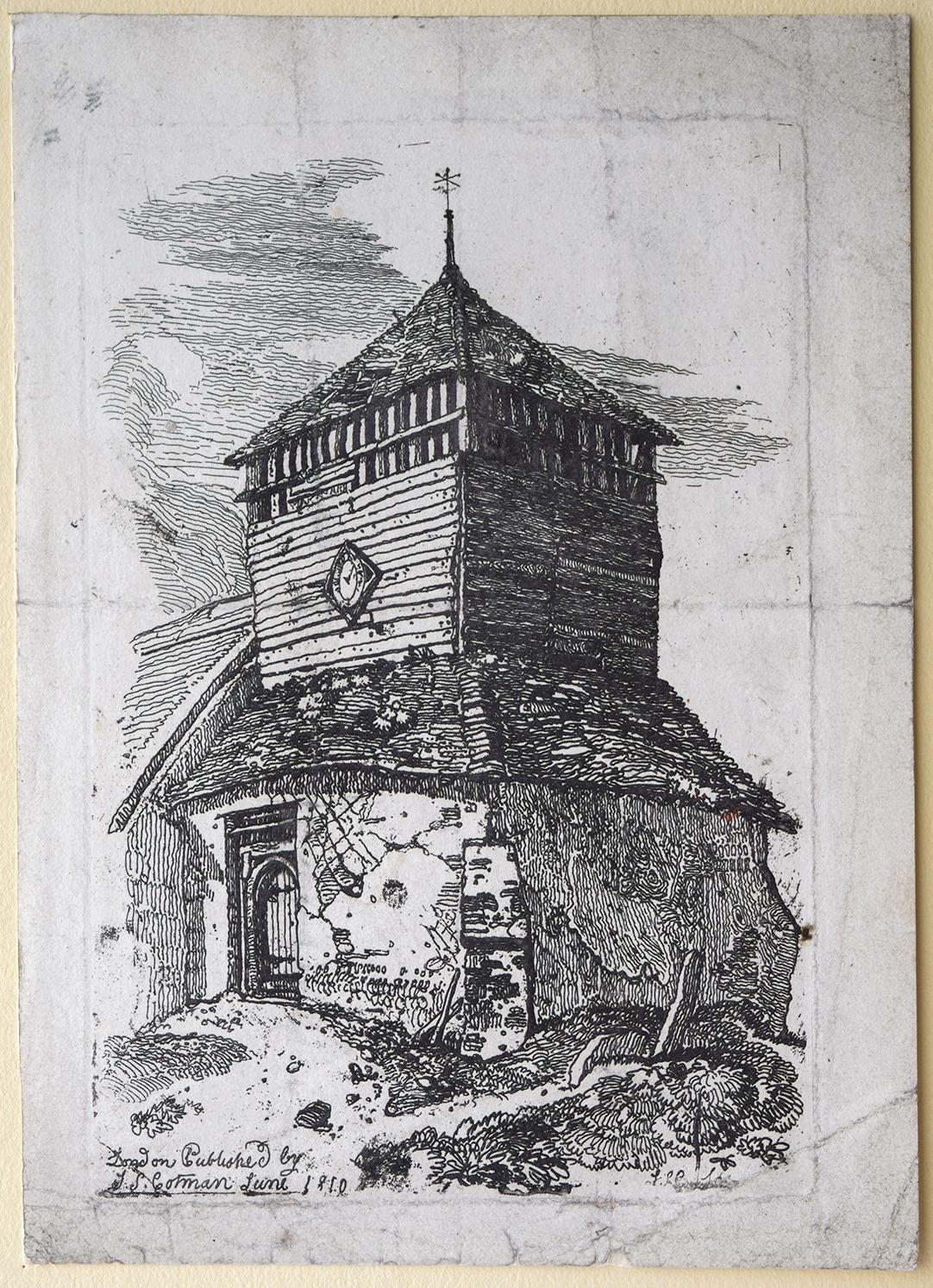
Church with Wooden Tower, 1810
Private collection
Photograph: Professor David Hill
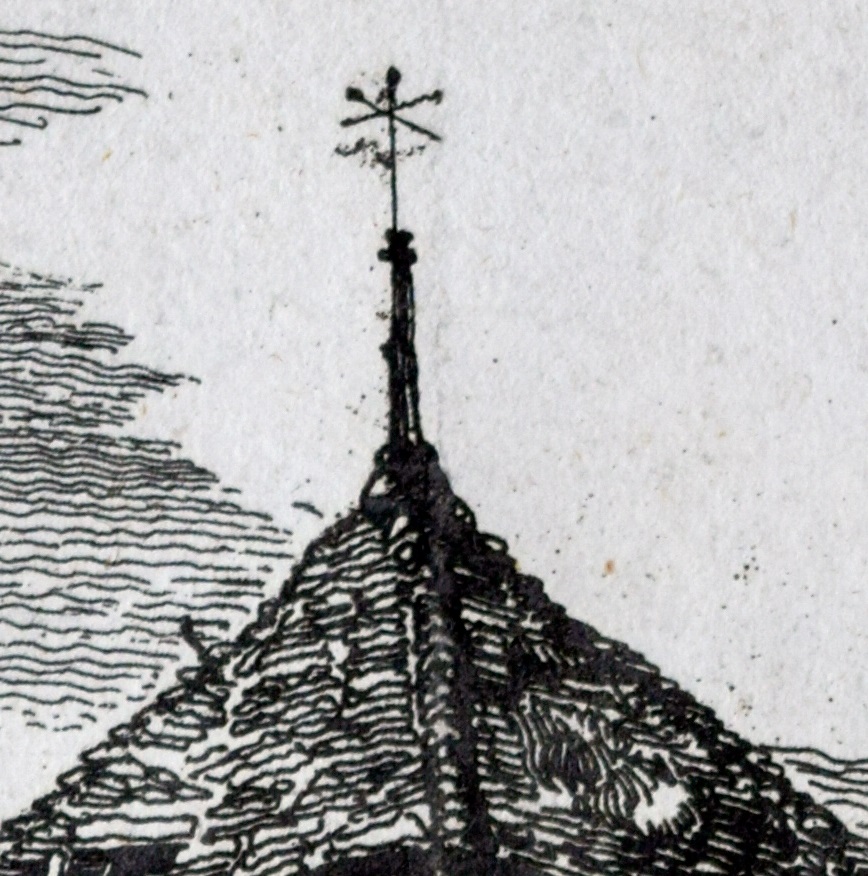
This is an upright composition of a somewhat dilapidated small rural church. The view is evidently from the north-west concentrating on the west end, entrance and wooden bell tower. The tower is squat, almost a perfect cube and clad in its lower part with horizontal planks, but shuttered above. It has a low pyramidal roof, apparently of tiles or shingles, crowned with a simple cross weather vane. The left face of the tower caries a clock within a diamond lozenge. The time reads ten minutes past ten. The tower rises out of a tiled belfry carried on rough-plastered walls with buttresses at each corner. The left face has a plain gothic wooden door let into simple rectangular opening. There is no identification of the subject, but Cotman has inscribed in the plate lower left: ‘London Published by/ J.S.Cotman June 1810’, and initialled his authorship lower right: ‘J.S.C. Sc’

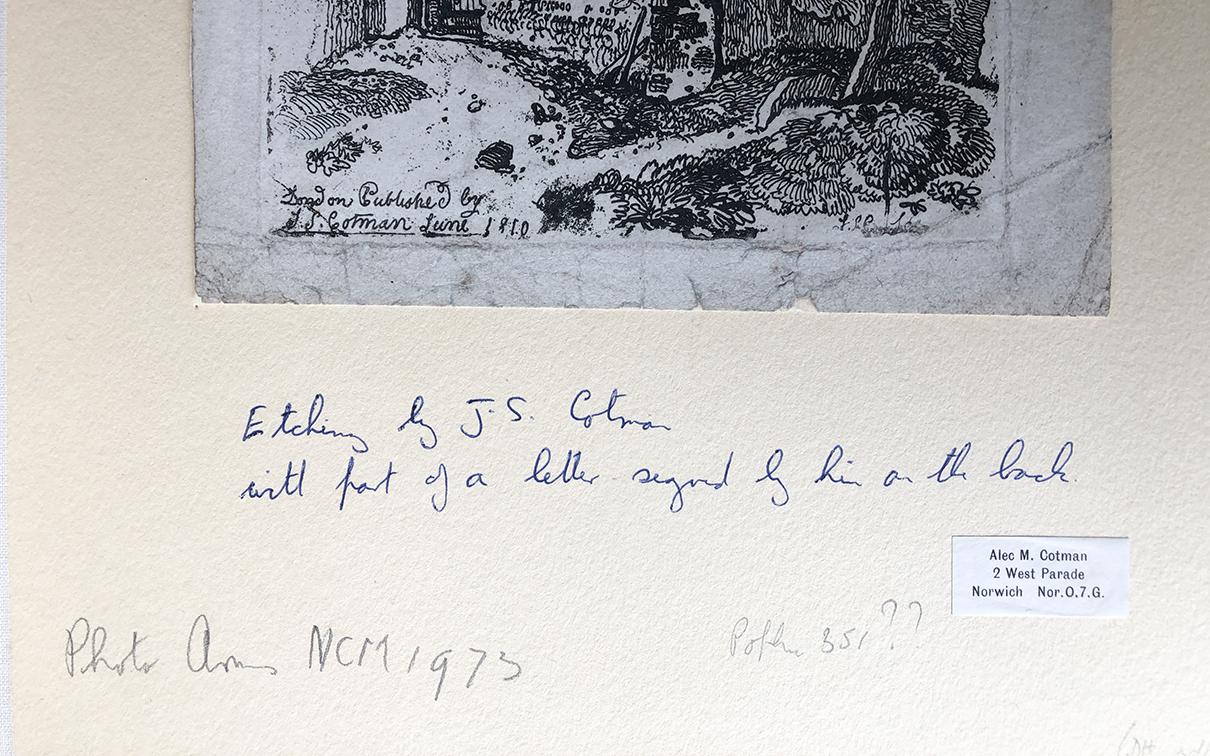
This etching was unknown to me before its appearance in the Cotman family sale at Dawsons of Maidenhead on 25 May 2023, lot 8. The mount bears the collector’s label of the artist Alec M Cotman (1907-1981), grandson of Cotman’s artist’s nephew Frederick George Cotman. There are various inscriptions on the mount in biro and pencil, presumably all by Alec Cotman.
The sale included a large number of works by members of the Cotman family. The full catalogue may be accessed here, and the auctioneer’s press release on the provenance of the collection here.
Another impression appeared in the same sale as one of a miscellany of four, lot 11. Prior to that, the subject appears never to have been reproduced or remarked upon in any published source. It is not mentioned in the listing of Cotman’s etchings published by A.E.Popham in 1922. No other impressions are known, and it may well represent Cotman’s very first attempt at etching
No etching is known with an earlier date, and only one with the same date of June 1810. That is a larger plate of An Old Wooden Cottage with A Pond in the Foreground (see unpublished plates #2). That, however, is far more ambitious and accomplished. The present etching is much more tentative.
The subject is unknown, but Simon Knott, author of the East Anglian Churches websites for Norfolk, Suffolk, Essex and Cambridgeshire, suggested in an email of 28 May 2023 that it was typical of a number of early Mid Essex churches such as that at Mundon near Malden.

The similarity is striking, but not exact. It also seems likely that the subject will have been reversed, for the etching on the plate prints to the paper as a mirror image. In that case, the original door would be on the south side not the north.
Whatever the specific identification, the church is presumably one that Cotman had actually visited. No pencil sketch of this subject is known to me, but the question nonetheless arises of what might have taken him there and the artist has no known association with the Mid Essex area. The plate was etched in London, so possibly it stood nearby wherever he was staying to learn the craft. Sadly nothing has yet been discovered of those circumstances.
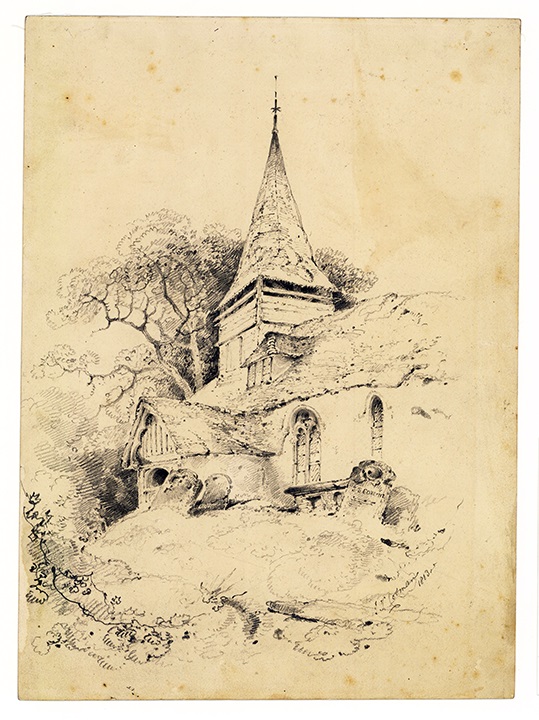
The Porch and Tower of St Mary’s Church, Norwood Green, London, 1803
Graphite on Bristol Board, 345 z 252 mm
Leeds City Art Gallery 1949.660

The Porch and Tower of St Mary’s Church, Norwood Green, London, 1803
Watercolour on paper, 508 x 305 mm
Bacon Collection
Cotman had a distinct leaning to the anti-heroic. One of the first churches of this kind is that of St Mary’s, at Norwood Green, Middlesex of which he worked up in 1803 a fine studio pencil and a watercolour. It stands on the western edge of Osterley Park about ten miles west of the centre of London. Cotman presumably had some connection to the area, although no details have yet been established.

Norwood stands at the head of a succession in Cotman’s career in the underwhelming, the neglected and the decayed. A pleasingly obscure example, West End of Braysworth Church was given a place in the published series (see plate 12).
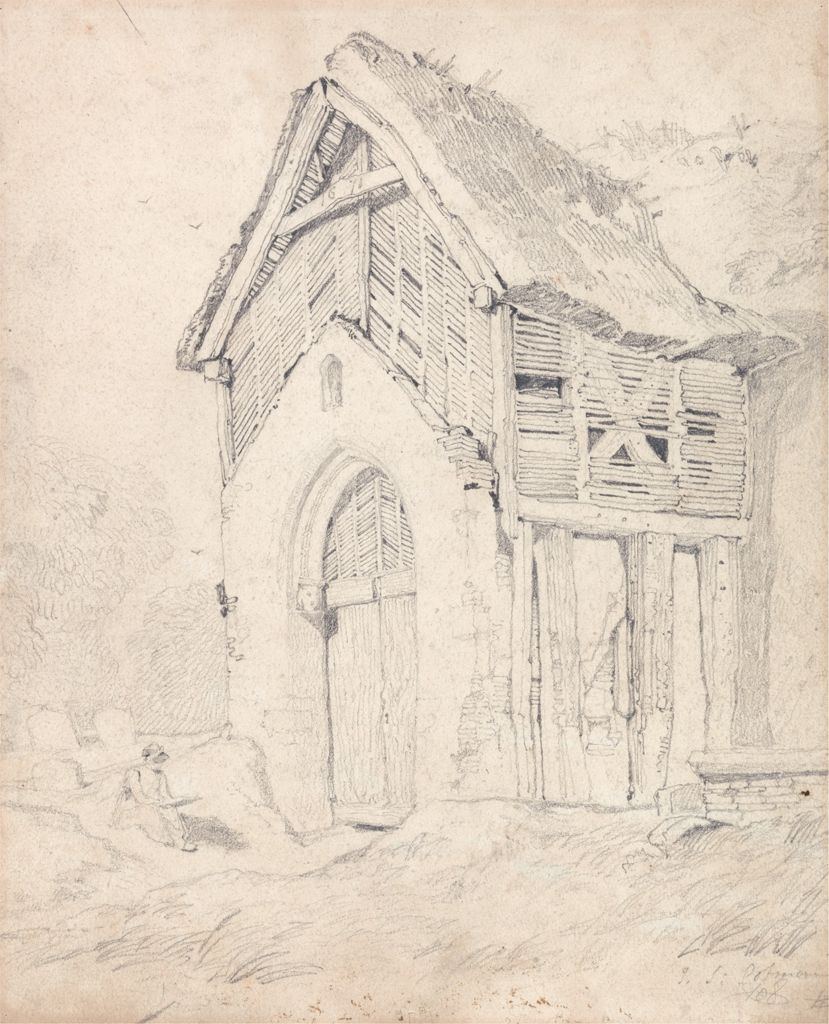
Porch and Belfry of Thurgarton Church, Norfolk, c.1810
Graphite on Paper, 11 1/4 x 9 1/8 inches (28.6 x 23.2 cm
Yale Center for British Art, Paul Mellon Collection
One of the most wilful and entertaining of Cotman’s architectural non-entities is a study of the Porch and Belfry of Thurgarton Church, Norfolk, drawn as a putative subject for a later Norfolk etching. Cotman must have known that this would challenge if not positively antagonise the taste of most of his audience, and he never published the etching. But the very fact that he bestowed sufficient interest on it to complete a fine drawing and carry the etching to completion suggests that he saw real purpose in such material. His inclination to the bathetic was clearly programmatic. We have noted many such instances in this catalogue. It must surely be worth wider scholarly consideration.

The impression of the present print sold at Dawsons on 25 May 2023 lot 8 has almost as much interest on the back as the front. The verso had been used to write a letter and the sheet then folded for despatch. The bottom half of the letter has been rubbed, and is today unreadable to the eye. Alec Cotman attempted to decipher it when in his possession, and his transcript was tucked under the back of the print:

My reading differs only in a a couple of respects, but remains far from being definitive.
As we have an opportunity of
Sending – we beg to report Mastr Cotman
As doing well – The Doll is for Pam
Hope she is well – & continues [deleted] behaves
Well – & arrived well without being
Sick upon the cushions. – You may
Return an answer by Miss Mary and
[?this] will I have no doubt bring a
[.. .. ..] Sav[..] many [?pres..]
A Servant [..] [.as ..] can – [?fren..]
Of 5 or [.. .. ..] so don’t
[?thoroughly] [.. .. .. .. .. ] will
[.. .. .. .. .. .. ] in big haste
J S Cotman[?]
Friday
I am currently exploring the possibility that modern multi-wavelength optical scanning might help resolve the detail.. For now, perhaps the most significant revision is the name in line 2. I read that as “Mastr Cotman”. Given the date of the etching as June 1810, this would most likely relate to Miles Edmund Cotman who was born on 5 February 1810. We cannot decipher enough of the letter to be certain about the context or occasion but presumably there was some concern of the young Cotman being unwell, and the father responding reassuringly. Another re-reading is of the name in line 7 as ‘Miss Mary’. The field is impossibly wide but one candidate might be Mary Anne Turner, the daughter of Cotman’s Yarmouth patron Dawson Turner, who was born in 1803. She would thus have been seven in 1810 and might well have started taking drawing lessons at Cotman’s drawing school in Norwich. It remains a mystery who [or what – perhaps a dog or cat??] might have been the ‘Pam’ [if that is the right reading] mentioned as the recipient of the doll in line 3. She appears to have been a visitor to Cotman, and a member of the recipient’s family, and to have travelled home in a carriage sufficiently luxurious for the cushions to have been a concern.
It is frustrating not to be able to identify the recipient or the full dramatis personae but the sheet still stands as a remarkable instance of Cotman recycling his artwork. There are several other instances. When working on Cotmania.org, the online catalogue of the Leeds Cotman collection, I was surprised on several occasions to find that Cotman used the backs of existing drawings or prints as sketching or writing material. One particularly thought-provoking example is a fragment of a drawing of Gillingham Church that was cut up for the sake of a quick sketch of a boat on the back.
It is curious that Cotman appears to have had very little sentimental attachment to his productions. Given that he is likely to have struck only twelve impressions from this plate (see unpublished plate #2) he seems to have had no thought of preserving them for posterity. Using an impression as a sheet of writing paper, seems to show a distinct lack of any archival imperative. On the other hand, a discerning eye might well have recognised the exclusiveness of Cotman’s choice of stationery. The fact that the sheet was preserved speaks well of the recipient
Summary of known states:
Unpublished Proof
Line etching, almost filling plate 217 x 147 mm (81/2 x 5 3/4 ins) printed in black ink on [Alec Cotman impression] heavyweight, stiff, white wove paper, trimmed to 252 x 180 mm (9 15/16 x 7 1/8 ins). The sheet later folded and used as a letter.
Inscribed on plate lower left ‘London Published by/ J.S.Cotman June 1810’ and to right ‘ JSC Sc’.
Collection: only two impressions known, both sold at Dawson’s auctioneers, Maidenhead, 25 May 2023, lots 8 and 11.

 Sublime Sites
Just a minor query – although you state that this etching ‘appears to have been unknown before its appearance in the Cotman family sale….etc’, one of the inscriptions on the mount which is not wholly legible ‘Photo A(…) NCM 1973 (?)’ implies that Norwich Castle Museum had a photo of it in 1973 and therefore knew about it then – so there might be something about it in their files? Miklos or someone there must have had a thought or two about it surely?
Hi Jeremy
Thanks for the suggestion. The claim that it was unknown was mostly subjective, and I’ll make it so. Alec Cotman presumably recognised its significance, and he was a respectted authority in his own right, besides being a well-known artist. He must have been in regular conversation with the Castle Museum and Miklos Rajnai. I did once look through the Castle Museum’s photo files, and Miklos Rajnai’s photo collecion and notes, but that was about 2000 and I was interested exclusively in Yorkshire subjects. I’ll certainly follow up your suggestion and contact them.
Another minor query about this etching and just as problematic as any other: the bellcote has horizontal temporary plank patching above the clock. It appears to have along the bottom ‘plank’ what might possibly be lettering – indecipherable (and perhaps not even lettering but just random texturing / wattling) – that might spell out a name / place name. If you have better software than me you might be able to take a look and rule it in or out as worth considering, but even a good hand lens might suffice given you have the actual print. Incidentally, on the subject of reproduction clarity, the Tate sketchbook plates you are illustrating in your Turner Seine / Jumieges subjects, are so faint in some cases as to be impossible to view.